Your basket is currently empty!
Category: Uncategorized

How to use buyer journey keyword research to unlock SEO-generated revenue

I know the impact of ignoring buyer’s journey keywords all too well. Early in my SEO career, I generated two million clicks for an ecommerce store. The client and I were thrilled. The graph on Google Search Console was trending strongly up.
I know the impact of ignoring buyer’s journey keywords all too well. Early in my SEO career, I generated two million clicks for an ecommerce store. The client and I were thrilled. The graph on Google Search Console was trending strongly up.
The problem? I couldn’t quantify a single sale from two million visitors. I had no idea how to generate a keyword strategy for buyers.
![Download Now: Keyword Research Template [Free Resource]](https://no-cache.hubspot.com/cta/default/53/447dd5f8-1426-4fb6-af75-b6e55bb759a2.png)
I learned my lesson the hard way. Now, everything I do in SEO is centered around the buyer and the end goal: a sale. Using buyer journey keywords, I can better quantify the value of my work. I know which landing page converts and which keywords influence sales, and I can quantify the monetary contribution articles had on sales. Keep reading to learn how.
Table of Contents
- The Role of the Buyer’s Journey in Keyword Research
- Keyword Intents for Each Buyer’s Journey Stage
- How to Do Keyword Research for Each Stage of the Buyer’s Journey
- Tips for Doing Keyword Research Aligned With the Buyer’s Journey
The Role of the Buyer’s Journey in Keyword Research
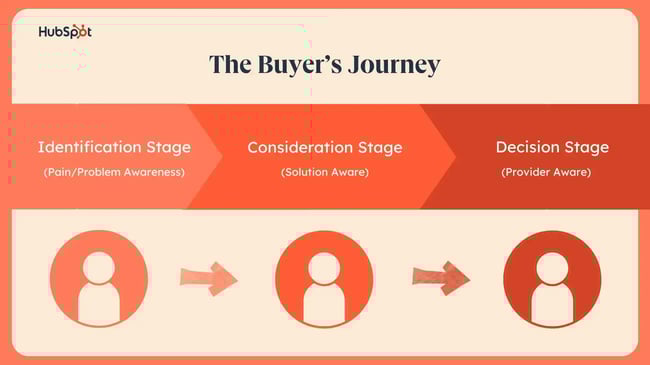
The buyer’s journey includes the steps a potential buyer will take before they purchase. SEOs who want to serve buyers and sell products or services need to understand the buyer journey to effectively strategize content.
Generally, the buyer journey will have three stages:
- Identification = pain and problem awareness
- Consideration = solution awareness
- Decision = provider aware
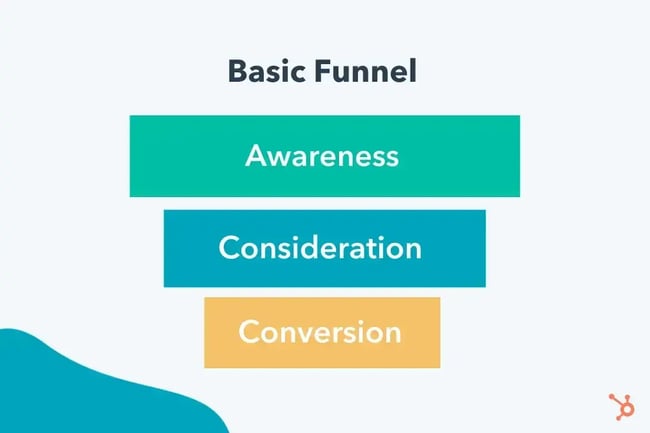
Sometimes, it’s represented in a funnel, known as the marketing or conversion funnel. I’ve placed an image of one below. You may also know these stages as:
- Awareness = Top of Funnel (ToFu)
- Consideration = Middle of Funnel (MoFu)
- Conversion = Bottom of Funnel (BoFu)
Understanding buyer’s journey keywords will pivot your SEO strategy from clicks to revenue, which matters for every business. Google is serving more of your potential buyers with AI overviews, which appear in 47% of results. Now, people can just read the AIO without clicking a link. So, SEOs must be tactical to win clicks and conversions.
Keyword Intents for Each Buyer’s Journey Stage
Each buyer journey stage has a separate need that you need to meet by matching the right keywords to the right stage. Meeting the buyer at different stages on their journey isn’t always about sealing the deal but building relationships.
In the State of Marketing survey, HubSpot found that marketers believe that building connections across the buyer’s journey and developing relationships at scale introduces new operational needs.
Awareness
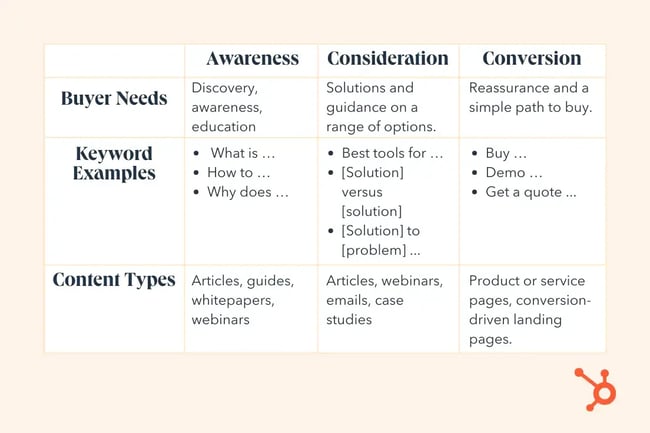
The buyer has identified a problem but doesn’t fully understand it or doesn’t know a solution exists. They are seeking general information or education to clarify the issue. This stage is about discovery and research.
This stage of the buyer journey needs helpful, educational content to better understand the problem or opportunity.
Keywords for this buyer journey will be problem-based and question-driven, such as “how to,” “why does,” or “what is.” These terms align with the buyer’s intent to learn and explore their situation without feeling sold to.
Here’s an example of a buyer in the awareness stage and the keywords to support them.
Consider that a buyer in the awareness stage is using keywords about a problem. For example, a sales manager might research:
- Why doesn’t my team follow up with leads?
- How to motivate a sales team.
- Processes to manage leads.
During this stage, content wants to educate the buyer. While this top-of-funnel content might not seem the most impactful for sales, according to Hubspot’s State of Marketing survey, the website and blog are some of the most effective channels for ROI.
Consideration
The buyer understands the problem and is exploring different approaches or solutions. They are actively researching options and comparing them.
This stage of the buyer journey needs solutions and guidance on which route might be best for them.
Keywords for this buyer journey will be comparison and solution-oriented keywords like “best tools for,” “top strategies,” “[solution] versus [solution]” or “solution to [problem].” These help your content show up when the buyer is evaluating ways to solve their issue.
Here’s an example of a buyer in the consideration stage and the keywords to support them.
Let’s stick with the example of a buyer looking for a CRM. In the consideration stage, they will know what their options are, and they might be overwhelmed. They are looking for support and want help weighing up solutions.
Conversion
The buyer is ready to make a decision and take action. They’ve narrowed down their options and are looking for reassurance, offers, or reasons to choose your product or service.
This stage of the buyer journey needs to reassure the buyer’s confidence in your solution and make conversion easy and tempting.
Keywords for this buyer journey will be targeted, intent-driven keywords like “buy,” “get a quote,” “pricing,” or “
near me.” These align with transactional searches and indicate the buyer is close to making a purchase.Here’s an example of a buyer in the conversion stage.
If looking for a CRM, the buyer is ready to click “Start Free Trial.”
The key things to understand are:
- Every buyer goes through a series of stages before they buy.
- Not every buyer starts at the awareness phase.
- The three stages above could be considered broad stages, and each has its own nuance, varying by industry, business, customer, and more. You need to understand your buyer’s journey before you can serve them.
- At each stage, buyers have different needs.
How to Do Keyword Research for Each Stage of the Buyer’s Journey
Now you understand the context of the buyer journey, each phase, and some ideas of keywords, I’ll walk you through a step-by-step process of how I do keyword research for each stage of the buyer’s journey.
When doing keyword research, it’s tempting to start from the top with the awareness stage, but I reverse this process and start at the bottom buyer journey stage, conversion. I start with conversion for two main reasons:
- Conversion-driven keywords are the most important.
- Starting with conversion keywords keeps me focused. You can quickly become overwhelmed by the content opportunities starting ToFu.
Stick with me as I share the complete guide.
Step 1: Prepare a Google document.
I love to record my buyer journey keyword strategy on Google Sheets. For now, you don’t need to do anything fancy.
Simply set up a document and save it somewhere safe. You will use this document to import all your keyword research.
Step 2: Identify your bottom-funnel keyword.
There are many ways to gather bottom-funnel keywords. If you have a strong and well-managed ads account, start there.
Use Google Ads to identify buyer journey keywords for bottom-funnel keywords.
To find keywords that convert, follow these steps:
- Sign in to Google Ads.
- Click “Insights and Reports,” then “Search Terms.”
- Filter the table by the highest conversions.
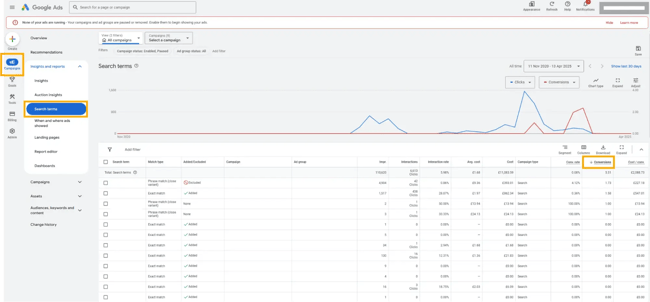
The screenshot above shows a redacted Ads account for one of my clients. It shows the steps you take to find the keywords.
I want to note that not all keywords in the ads account work. The highest-converting keyword is excluded because although it received conversions, it didn’t get sales. The ads manager excluded this keyword, so SEO should likely exclude it, too.
Top tip: Many of the highest-converting keywords will include your brand name. You will be ranking for these anyway, so don’t focus on them. Choose keywords that you need to work on to increase rankings.
Research buyer journey keywords using SEO tools.
SEO tools such as Semrush offer insights into keywords, volumes, and intent. There are many on the market, but my favorite is Semrush, so I’ll demonstrate this stage using Semrush’s Keyword Magic Tool.
On your chosen keyword research tool, add your head keyword. Your head keyword will be the product or service you are selling.
For this example, I’ve chosen “CRM.” Many keyword research tools allow you to filter results, including “transactional” keywords, which are likely to convert.
You need to:
- Identify your head keyword.
- Search it in your keyword tool.
- Filter results by “transactional” intent keywords.
- Manually review keywords, choosing the keywords that work for your business.

Top tip: Don’t worry too much about search volume and keyword difficulty. Generally, conversion keywords are the most difficult to rank for and often have lower search volumes. Remember the funnel from earlier? The smallest section is at the bottom, as users at this point in the buyer journey reduce.
Research buyer journey keywords using Google Search Console and G4.
Google Search Console is not the easiest way of identifying buyer journey keywords, but it is free, so I’ve included it.
To determine whether a keyword is helping you make sales, you need to understand how users engage with the pages the keyword drives traffic to.
First, let’s find pages that convert.
- Log in to G4.
- Navigate to Reports
- Navigate to Life Cycle > Engagement> Landing Page Report
- Filter by revenue
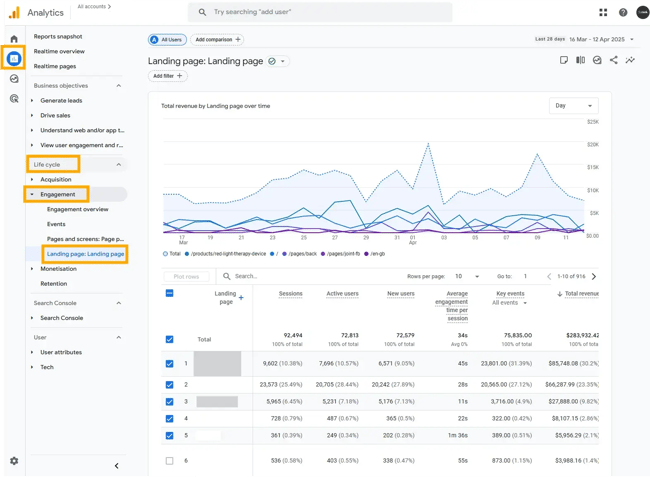
Take your highest-performing pages and analyze the URL in Google Search Console (GSC).
- Log in to Google Search Console.
- Go to Search Results.
- Click “Add Filter.”
- Add a page.
- Add the URL.
GSC will filter all keywords generating clicks for the page input. Review the keywords and identify if keywords are likely to result in a sale.
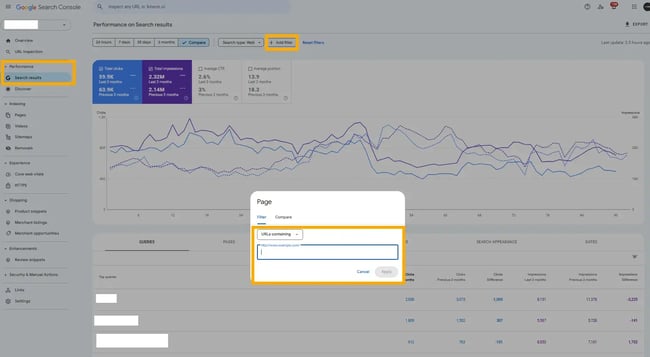
Top tip: Google Search Console won’t tell you which keywords are converting, so you’ll need to use some common sense.
Step 3: Conduct keyword research for middle funnel (consideration) buyer journey keywords.
From the stage above, you should have a list of keywords that you’d love to rank for. These are your bottom-funnel or conversion keywords.
Generally, these keywords are used on:
- Product pages
- Service pages
- Conversion-driven landing pages
Later, I’ll discuss keyword mapping so you know exactly where to place your keywords.
Before creating more content, though, I like to ensure I have the content available to support bottom-funnel pages in a way that builds E-E-A-T. I like to start with the next most important item, which is content that fits the middle-funnel buyer’s journey: Consideration.
The type of content we can use for keyword research includes:
- Case studies.
- Reviews.
- Some articles.
You likely already have these pages on your website. I might take these pages and put them into Google Search Console to see if I can find any relevant keywords. To do this, use the steps above for keyword research and filter by page.
Important note: Your review keywords are really important and often missed by brands. I see too many websites that lack a review page and therefore give clicks away to review sites or even social media. You want a page on your website that showcases your reviews and manages your brand narrative.
Top tip: If you don’t find much in terms of keywords and search volume, don’t worry too much. Not every piece of content for the buyer journey has to be for SEO. Some content can be shared with other marketing departments via email, for example.
Step 4: Conduct keyword research for top funnel (awareness) buyer journey keywords.
Finally, I identify keywords for the awareness buyer journey stage.
Visualize the funnel from earlier. The funnel shape provides a visual for the traffic volumes at each stage of the buyer journey. Awareness is at the largest point of the funnel because it has the most searches, keywords, and users. As you get further down the funnel, it narrows because the audience gets smaller.
To do keyword research for this phase, I go back to Semrush, following the steps above, and navigate to the Keyword Magic Tool. I remove filters for the intent and look at Questions as well as keywords to see which keywords inspire content.
Important note: The tools do a fantastic job of providing keyword inspiration, but there is no replacement for talking to customers and your peers. Ask sales what types of questions people ask. Find out exactly who your target audience is and what they need from you. It’s very easy to get distracted at this stage. You must create content that your audience needs.
Creating the right content and targeting the keywords your audience needs has never been more important. With the rise of AI, top-funnel keywords get far fewer clicks as AI overviews serve the buyer. You need every click to count.
Step 5: Understand search intent and SERP analysis.
These next two steps are my favorites.
You might already have an idea of where you’re going to use your keywords. Bottom-funnel keywords are generally pretty self-explanatory. “Demo CRM,” for example, clearly needs to go to a page where a CRM can be demoed.
Many keywords won’t be as self-explanatory, though.
I like to use Google in private browsing, so the search engine results pages (SERPs) are not tailored to my usual search history.
Let’s Google “best CRM for sales and marketing teams,” and I’ll show you how I analyze the SERPs.
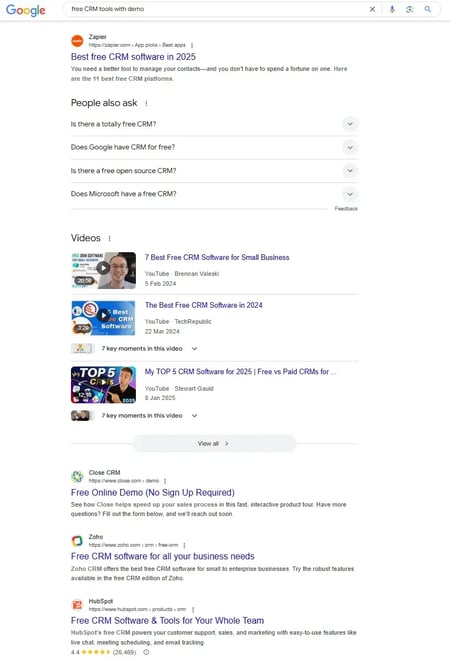
Here’s what I’m thinking when I look at these SERPs:
- Which pages are ranking? Looking at the organic listings, all pages, bar the top result, are product pages with “demo” or “free” in the URL and or title tag.
- Which SERP features are available? I can see People Also Ask, videos, and review snippets.
- Priority is given to the Zapier round-up article and videos.
From this information, you can gather:
- The type of page you need to rank (a product page).
- Components to include on the page (video, questions, aggregateRatings schema).
- Videos are a high priority and should be added.
What you’re doing here is using Google’s “understanding” of the searcher’s needs to determine what they want and what you’ll create to meet it.
Google has a complex algorithm dedicated to providing helpful content to its users. Google’s success in being helpful and providing quality information is paramount to its success as a search engine. It’s fairly safe to assume Google has search intent right.
Mimic the content Google is prioritizing (but do it in your own way), and you’ll likely meet user needs.
Step 6: Map keywords to pages.
As an extension of the step above, correctly map buyer journey keywords to the right content. This is called keyword mapping. You assign keywords to the page that have the highest possible chance of ranking.
Once you’ve done the first step, you need to correctly identify your supporting keywords.
A good example to illustrate this point is People Also Ask. I often see websites that see each FAQ as its own page or article, but this isn’t always the most efficient way to map keywords.
For the search “road bike for women,” People Also Ask provides the following questions:
- What is the best road bike for ladies?
- What size road bike do I need for a woman?
- Which bike is best for females?
- Are road bikes good for weight loss?
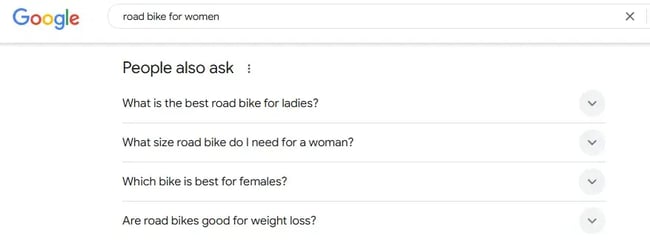
It would be a mistake to use the keywords “What is the best road bike for ladies?” and “Which bike is best for females?” as keywords for the same article.
You can see this in your SERP analysis. When Googled, you can see the ranking articles.
There is one commonality, but the rest of the articles are different. The keyword “What is the best road bike for ladies?” is more nuanced, bringing up results that mention “road,” whereas the other keyword is more general.
Important note: Although this search is an excellent guide, sometimes you need to use common sense and do what is right by your values and business. For example, if you only sell road bikes, you might choose to cluster those keywords together.
I like to record my buyer journey keyword map in Google Sheets. Here’s what my sheet looks like:
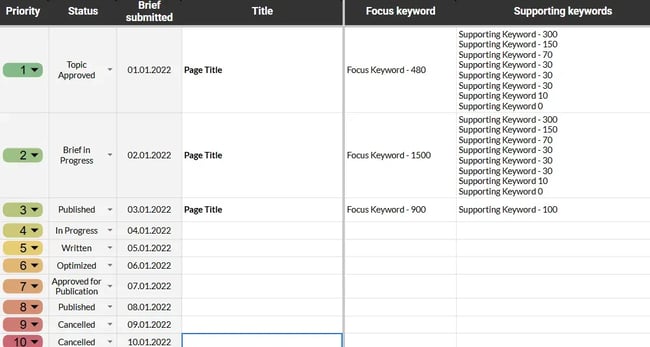
I record a draft title, the page’s focus keyword, and supporting keywords. This way, when I write the content, I know where the keywords are mapped.
If you want more support with SEO content writing, HubSpot’s SEO Marketing Software allows you to optimize your content within one easy-to-use-tool.
Tips for Doing Keyword Research Aligned With the Buyer’s Journey
Finally, here are some final tips to help you feel confident about keyword research aligned with the buyer journey.
Ask customers what they searched to find you.
This tip is easy to implement, especially in B2B, because the person on the other end of the phone likely understands. If you work in marketing, there’s a good chance the buyer will also respect your diligence.
Once you’ve built a good rapport with the prospect, ask them what they searched for to find you.
This information will give you exactly the type of keyword your buyers are searching for.
Start with buyer needs.
If you follow my process for buyer journey keyword research detailed above, you’ll do this, but I can’t stress enough the importance of starting with buyer needs. It’s very tempting to go to the tools and start finding keywords, but you really want to hone in on conversions and scale back from there, discovering impactful keywords that actually help your buyer.
Talk to sales and customer service representatives.
No one knows your customers like sales and customer service. Ask them which questions buyers ask frequently and what you can do in content to address common apprehensions and build trust.
Remember to repurpose content.
Although keywords and SEO are incredibly important, it takes time to rank in the top spots of Google. In the meantime, get content out to your users through other means: ads, emails, social media, etc.
Refer to Google Search Console regularly.
Google Search Console (GSC) data updates frequently. Keep a close eye on keywords you search, clicks, and impressions. Look for new opportunities to add more keywords to your content.
I like to look at high impressions and low clicks to spot keywords people are searching for.
Feeling conflicted about SERPs? Do the integral thing.
Sometimes, you’ll encounter a keyword map or SERP analysis that doesn’t quite feel right. You should always do what’s right for your buyer and business.
I always say that you should do the integral thing first. You might be surprised at what you can rank, even if the SERPs aren’t quite in line with what you want to create. You can always come back and compromise later.
Buyer Journey Keyword Strategy Helps You Qualify Content’s Role
SEO is notorious for being tricky in tracking its contribution to sales. It’s not like ads where you have keywords with sales assigned. Instead, you can only really assign click quantities.
However, there is a major benefit to buyer journey keywords: you know that not everything is created to convert. Some keywords are used on pages that convert, and others are there to build awareness. This means you can alter your tracking accordingly.
- For ToFu pieces, track clicks, impressions, newsletter signups, and return visitors.
- Use segment gap analysis to establish content (and therefore keywords) that contribute to the buyer journey and sales. You can create two segments: purchasers and users who viewed an article and bought it after X time. This helps show the role of content and keywords on the buyer journey..
- Track sales from bottom-funnel pages gaining clicks from bottom-funnel keywords.
- Monitor pages that are generating revenue and ranking only for non-brand keywords.
- Use ad data to determine SEO’s impact. If something converts in ads, then it likely converts organically, too.
Turn Your SEO Strategy Into a Revenue-Generating Machine With Buyer Journey Keywords
Since using buyer journey keywords and building a strategy from the bottom-funnel keyword, I’ve felt much happier with my SEO.
Upward trending graphs are still deeply fulfilling and exciting, but the benefit of generating revenue (and being able to prove it) is far superior.


Content aggregators can help you get more eyes on your marketing collateral — here’s how

Those who know me know that I have a healthy obsession with travel. So, I often pore over travel blogs looking for the best way to plan a trip and the best activities to do in a given place. One tool that will always help me find what I need is content aggregation.
Those who know me know that I have a healthy obsession with travel. So, I often pore over travel blogs looking for the best way to plan a trip and the best activities to do in a given place. One tool that will always help me find what I need is content aggregation.
Since they’re not solely for travel sites, content aggregator sites can be a useful strategy. Marketers can reach new audiences, and consumers can find relevant resources.
![Download Now: 150+ Content Creation Templates [Free Kit]](https://no-cache.hubspot.com/cta/default/53/5478fa12-4cc3-4140-ba96-bc103eeb873e.png)
In this post, you’ll learn what content aggregation is and discover high-quality sites.
Table of Contents
These sites can collect things like:
- News articles.
- Social media posts.
- Images.
- Videos.
- And more.
Essentially, content aggregator sites collect and repost content so viewers can see articles from various sources all in one place. Usually, these sites are set up to aggregate content through RSS feeds automatically.
So, now that we know more about content aggregation, see how you can get started.
How Content Aggregators Can Help Marketers
Content aggregation can help marketers distribute content on multiple platforms, making it easier for people to find you.
The major benefits that content aggregator sites have for marketers include:
- Expanded reach and visibility — likely in front of the right audience — since users rely on content aggregators to surface content that matches their interests (see example section below).
- Referral traffic from pieces on aggregator sites that pique the interest of users. If you manage to secure a feature, traffic should increase significantly.
- SEO benefits due to the link from a high-authority, relevant site.
- Content inspiration because aggregator sites allow you to see trending topics.
The more platforms you’re on, the more exposure you have to a variety of audiences. Given this, content aggregation is a tactic you could include in a brand awareness strategy.
Additionally, using content aggregators to distribute your business content can help you become involved in your community, especially if you encourage interaction. For example, people can leave comments, have discussions, and also have conversations with you.
Before you get started, it’s essential to understand how to pick a content aggregation site.
How to Pick the Right Aggregator Service

When it comes to picking the right aggregator service for your business, the most critical question is the type of content you’re hoping to share on it.
For example, there are specific sites for news stories, others for blogs, and others focused entirely on social media content — you want to pick the one that aligns most with your needs (our list below will help).
In addition, some aggregators cost money. If you have a strict budget, you’ll want to visit the pricing pages of services to see if there are any fees.
However, many services are free of cost and are curated by editors or algorithms, so your choice depends on your business needs.
Want to write content faster with AI? Try HubSpot’s free AI Content Writer.
Aggregation vs. Creation vs. Curation
There are a variety of ways you can provide valuable content to your audience. It’s important to understand which approach (or combination of approaches) best suits your business goals and your audience’s interests.
Content creation is the process of developing topic ideas and content for your target audience through written and visual products. This information is made available through blogs, videos, infographics, and other digital formats.
Top tip: If you need help creating content, you can use HubSpot’s content creation templates.
Content curation is a bit closer to content aggregation in that it is not original content. Instead, it is content that is curated and presented to the target audience.
The content is manually collected, organized, and annotated, so it often includes commentary and/or context.
Content Curation vs. Aggregation
As I previously explained, content aggregation is different from both content creation and curation in that it’s automatic and collects information based on keywords.
The content is gathered from different sources online and put together in one easy-to-find place.
This tool allows your audience to derive a lot of value from your distribution and aggregation with minimal and efficient effort on your end.
Each of these methods can offer a way to expand your marketing strategy and are worth your consideration. However, in this article I’m focusing on digital content aggregators.
Content Aggregation Tools
Now, let’s go over some different high-quality content aggregation tools that can be valuable to you.
Blog Aggregators
As implied in the name, blog aggregator sites focus on blog websites. They can contain general blog posts or more niche-focused aggregators, such as a travel blog aggregator that’s focused on travel blogging content.
1. Travel Blogger Community
Travel Blogger Community is a content aggregation site that I use when searching for travel blog content. You can request to have your content featured, and it is curated by editors.

Pro tip: Travel Blogger Community is a great example of a niche site that may also exist within your industry, so be sure to do some research if you’re going to implement a content aggregation strategy.
2. Flipboard
Flipboard is a popular blog aggregator that allows users to create a custom feed based on their interests.
What I like: Personalization allows you to create a profile, submit an RSS feed, and share your content. You can also create a personal storyboard with content related to your business and link to it on your website via social buttons.

3. The Web List
The Web List is a single-page content aggregator with original content from a variety of sources. It highlights the most popular items of the day at the top, then organizes other articles by source.

News Aggregators
News aggregator sites compile content from various high-quality news sources. These sites can be for general news, location-specific news, or industry happenings.
4. Google News
Google News displays the top news stories for the day, saving users a trip to their search engine.
You can’t submit your content to the site as it is curated based on search history and location, but if your site gains traction, you increase your chances of being featured.
Best for: Customization. Users can customize their feed by “following” specific topics, sources, or searches.

5. AllTop
AllTop aggregates content from various topics and sources, such as top news sites and social media forums.
Users can search for topics of interest and get the top stories or just browse through the homepage.
Pro tip: AllTop sometimes accepts site submissions, so be sure to check back periodically if you want to feature your content.

6. Pocket
Pocket is an aggregation site that features a wide variety of content that users can customize to meet their interests by clicking a “Follow” button. You can also bookmark content to read on the go on your mobile devices — hence Pocket.
Best for: Anyone! There is a wide range of categories, from tech to finance to travel.

7. WP News Desk
WP News Desk is a unique aggregator site that focuses on content related to the WordPress community.
You can’t submit your own content to be featured, but if you run a high-quality WordPress blog that is informative for users, you may find your site featured on the aggregator.

8. Feedly
Feedly is a content aggregation site that’s focused on helping users create their own feed, so they aren’t overwhelmed with information overload.
Pro tip: The site has both free and paid plans, so users can aggregate content from as many sources as they want and across any niche.

9. Techmeme
Techeme is a niche news aggregator site that provides readers with the top news stories about technology-related topics, curated by editors.
In addition to the homepage, which features the day’s top stories, you can also choose the River view to see live updates or the Leaderboard view to find articles by topic.
Pro tip: You can pay to have your content, event, or job listing posted on Techmeme, so if you’re in the tech business, this may be a great resource to tap into.

Information Aggregator Websites
Information aggregator websites contain exactly that — information. This can include blog posts, news stories, links to social media content, and any information that users can benefit from.
10. Upstract
Upstract is a popular information aggregator. It allows users to choose the platforms they want information from to create a custom feed.
What I like: The crazy variety — it pulls from Reddit, Huffington Post, The Verge, Google News, Wired, and even TikTok, setting them all side-by-side.
While you can’t submit your site to be included in this aggregator, it’s nevertheless a powerful platform to be aware of if you’re going to start using content aggregation.

11. Panda
Panda offers both a website and a Chrome extension specifically curated for developers, designers, or just anyone who identifies as an entrepreneur.
It allows you to stay up to date with industry news from sources such as Hacker News, TechCrunch, and GitHub.
What I like: It is presented in an easy-to-use and aesthetically pleasing manner, making it the perfect content aggregator for anyone in the industry.
However, keep in mind that Panda doesn’t allow user submissions. Therefore, your feature may just come about if your content rises to the top of any of these notable news sites.
12. Reddit
Reddit is a household name, and if it isn’t in your home, then you must be living under a rock. However, it is also one of the most popular information aggregator sites.
It features trending topics from all different areas of interest while also providing a forum where people can comment and discuss the latest news.
Pro tip: As I’m sure you know, members of the site can submit content such as text posts, images, and links. Therefore, it’s a great tool for marketers to spread their word further.

Social Media Aggregators
Social media aggregators compile high-quality content from sources such as Instagram, Facebook, YouTube, and TikTok. Most social media aggregators help markets find user-generated content to share with their audience to build brand trust.
13. TaggBox
TaggBox is a social media aggregator focused on helping marketers develop brand trust and engagement through user-generated content.
You create an account, select the tags that are relevant to your business, and you’re shown posts across different social media platforms that your audience has made about you.
Pro tip: You also have the option to create a social feed of user-generated content to display on your own website, helping site visitors see your content in action and generate trust from other consumers.

14. Tagembed
Tagembed collects and curates engaging social media content related to your business that you can then display on your website.
What I like: You can generate a social feed from multiple sites and share the custom content within your site for all users to see.

15. Curator
You can draw posts from the most popular social media sites to create and share your own feed on your business’ website.
You can choose whether the posts automatically appear on your site or whether you manually approve each one first. Curator offers free and paid plans.
Best for: Building brand trust by sharing customer posts with prospects and site visitors.

While it may not make up the core of your marketing plan, content aggregators are a unique and exciting tool for marketers to use to share their content and gain exposure while simultaneously becoming involved with your community.
Start Using Content Aggregators in Marketing
If you’re creating content in marketing, then you might consider making content aggregator submissions a part of your process.
As a marketer and a blog writer, I make sure I submit to content aggregators when I’ve created a piece of content that will work for an aggregator. I suggest creating a sheet using Google Docs. Then, pull all the relevant examples from above, plus a note for those you can manually submit to, then make submitting the content a part of the process, as natural as writing it!
Editor’s note: This post was originally published in March 2020 and has been updated for comprehensiveness.


Build Trust by Saying What Others Won’t
Build Trust by Saying What Others Won’t written by Jarret Redding read more at Duct Tape Marketing
The Duct Tape Marketing Podcast with Marcus Sheridan In this episode of the Duct Tape Marketing Podcast, I interviewed Marcus Sheridan, renowned speaker, author of They Ask, You Answer, and a leading voice in the world of content marketing and business transparency. Marcus built the most visited swimming pool website in the world and has […]
How to Think Strategically About AI Tools written by Jarret Redding read more at Duct Tape Marketing
The Duct Tape Marketing Podcast with Dan Sanchez
In this episode of the Duct Tape Marketing Podcast, I interviewed Dan Sanchez, an AI marketer, consultant, and the creator behind AI-Driven Marketer. Dan has a deep passion for exploring how artificial intelligence can be used not just for automation, but as a co-pilot in crafting better strategies, solving complex business challenges, and enhancing marketing productivity.
During our conversation, Dan shared powerful insights on how AI is transforming the role of marketers and why approaching AI with a clear strategic mindset is more essential than ever. We explored the pitfalls of chasing the newest shiny tool and instead emphasized focusing on core business problems where AI can truly add value. Whether you’re overwhelmed by the flood of new tools or just starting out, Dan’s advice is rooted in the philosophy of strategy before technology—an ethos that’s been central to Duct Tape Marketing for over two decades.
Dan’s grounded approach to integrating artificial intelligence into marketing underscores the importance of being intentional and strategic. Rather than seeing AI as a threat or a gimmick, marketers can embrace it as a powerful tool to elevate their impact and performance.
Key Takeaways:
-
Start with strategy, not tools. Focus on identifying bottlenecks in your business processes before selecting any AI tools.
-
Use AI as a thinking partner. Tools like ChatGPT can enhance strategic thinking, not just content creation.
-
Go deep, not wide. Master one tool—like ChatGPT or Claude—instead of juggling a dozen, to get real value from AI in marketing.
-
Deep research is underutilized. Tools that simulate 20–40 hours of human research can drastically improve marketing strategy and productivity.
-
AI can reshape problem-solving. Learn to prompt AI effectively to assist with everything from competitive analysis to content ideation.
-
Stay focused, not overwhelmed. You don’t need to be an early adopter of every tool—start with meaningful experiments and scale from there.
-
AI will shift marketing roles. Embracing AI skills will be key to thriving in the future of marketing and business growth.
Chapters:
- 00:09 Introducing Dan Sanchez
- 01:57 Approaching AI Strategically
- 04:04 Creating New Things with AI
- 06:36 Evolution of AI Prompting
- 08:50 Humans Changing Role in Marketing
- 11:38 Developing Skills vs Delegating Tasks
- 13:51 AI Agents Affect on Marketing
- 17:50 Advice on Using Deep Research
More About Dan Sanchez:
Sara Nay (00:01.468)
Hello and welcome to the duct tape marketing podcast. This is your host, Sara and a today I’m stepping in for John Jance and I have a guest on the show, Dan Sanchez. So Dan is an AI marketer, consultant and creator with a passion of diving into the latest tech innovations. He specializes in developing cutting edge marketing strategies that leverage AI to enhance customer engagement and drive business growth. So welcome to the show, Dan.
Danchez (00:27.64)
Thanks for having me on, Sarah.
Sara Nay (00:28.978)
Of course, I’m excited to talk to you today. We first connected on LinkedIn because you had been posting about AI and thinking strategically about AI and speaking to marketers directly, which all of that resonates with me. But when I reached out to you, I was commenting about one of your posts and I’m just curious, do you remember what you said in response to my initial message to you? No, I put you on the spot.
Danchez (00:48.364)
I don’t. If we’re talking about the comments, I’m like, I don’t know. I comment, I mean, I’m dropping 200 comments a day or a week on LinkedIn. And so they all blur together sometimes and I’m like, I don’t know what I said, when I said it.
Sara Nay (00:56.36)
I’m sure.
No worries. Well, I sent you a direct message and you talked about how duct tape marketing was one of the initial blogs that you were following back when RSS feeds were a thing.
Danchez (01:02.882)
or the direct message. Yes, no.
That’s right. It was Copy Blogger, Duct Tape Marketing, and Seth Godin were the three. I was transitioning from graphic design to being a marketer, and a marketing kind of mentor to me. He’s like, hey, back when RSS was a thing too, he’s like, go to create a Google feed account and subscribe to these three blogs. You need to read them every day. And so I did for a very long time.
Sara Nay (01:29.33)
I love it. just brought that up because I think it’s very interesting. Like you’ve obviously been in the marketing space for a while now talking about RSS and original blogs. And now today the focus of this conversation is going to be all about AI. And so it’s just interesting to think about the evolution that we’ve had over the last several years and the pace of the evolution that we’re going through right now with all things AI. Well, great.
And that’s what I want to dive into deeper. I’ve noticed through your posts and the content that you’re putting out, you’re talking a lot about approaching AI strategically to avoid overwhelm. at Duct Tape Marketing, we’ve been saying strategy before tactics for 20 years now. At this point, we’re saying strategy before technology because you need to have a solid strategy in place. But I would love to open that up to you. How are you advising because it can be overwhelming with all the tools that are being developed and all the
the stuff that’s being put out there on AI. So how do you advise people to approach the world of AI strategically?
Danchez (02:24.27)
You know, there’s a couple different approaches, but it’s funny because I just got a DM yesterday and it was like, hey man, heard you did a talk on the 25 new tools for AI in your session recently. What tools should I use? And I was like, I don’t know, what problems are you facing? It’s kind of like that whole strategy thing. It’s kind of like, well, there’s lots of tools. They can do lots of stuff. And there’s some general purpose tools that can cover a lot of different things.
Sara Nay (02:44.892)
Yeah.
Danchez (02:51.822)
But what’s the core obstacle you’re running into your business with right now? Where’s the choke point for your systems? What’s causing you pain on a daily or weekly basis? Because those are the things I want to look for first as a consultant and see how AI might be able to help that. It’s funny because a lot of times people actually don’t need AI, they just need clarity and a strategic focus set. But I do find that AI is changing the game because it’s allowing us
Sara Nay (03:00.774)
Yeah.
Danchez (03:20.982)
not only to automate and do things faster or even better, but it’s helping us think better and more strategically if you kind of know how to use it as a co-pilot. So that’s the first thing I’m kind of trying to help people understand is like this thing becomes a very good strategy thinking partner. Even if you can kind of, you just kind of have to give it a start. It’s not going to proactively come after you and be like, Hey, so what’s your plan for this? Hey, what’s your strategy? Hey, what were you thinking here? But if you proactively ask it for feedback,
Sara Nay (03:26.93)
Mm.
Danchez (03:48.608)
or for considerations or ask questions that it can ask you and then give you feedback on, it’s amazing how much more strategically you can think when you start using AI as a co-pilot.
Sara Nay (04:00.528)
Yeah, absolutely. And that was one of my early aha moments with AI is at first I was just using it or thinking about it as like a content creation tool. was thinking of it as something that like helps take stuff off my plate. But when I shifted to thinking of it as a thought partner and started using it in my strategic thinking and planning, like that’s where my view on what AI can do completely changed. And I know you have a story that you talk about one of your early on experiences with chat, GBT, I think you call it your Mediterranean ice cream moment. Do you mind explaining what that experience was for you?
Danchez (04:26.838)
Yeah, that’s right. Yeah, it’s when ChatGPT first came out. I’d been a huge skeptic of AI before ChatGPT came out. I’d seen some of the early pre-ChatGPT stuff like Jarvis, which was using its 2.5 API ChatGPTs back then. It was like a copywriting tool and I was like, okay, it’s starting to get things. But when ChatGPT launched, it woke everybody up, including me. And I remember sitting there and being like, well, is this thing just really good at regurgitating?
You know, is it like, because remember before we had like Drift, you know, an AI chat bot and we had Intercom and like they were all pretty bad. None of them were good. So I was like, you know, can this come up with original ideas? Most original ideas are usually a combining of two different things that don’t normally come together. And humans do it all the time to come up with new ideas. So was like, well, let’s find something that doesn’t exist on the internet and just ask for it to create something. So I figured recipes would be hard because I’m like, well, that’s a whole different dimension. It’s got to understand taste and
recipe and how things come together in order to form new flavors. That’s pretty tough. And then I went searching, I’m like, what’s a recipe that doesn’t exist? So I just picked out two random flavors. I was like ice cream Mediterranean. I went and Google searched it. Could not find it. And then search and said, hey, make me a recipe for Mediterranean ice cream. And it punched out a bunch of ingredients. was like, you know what? This would actually work. And that’s when I realized, I’m like, it has the ability to come up with new things.
If you’re willing to guide it direct it and that changed everything for me because that was the missing piece That’s what to me made it artificial intelligence is it was able to actually think through and come up with a very Kind of elaborate thing because making recipes is kind of hard if you’re not pretty familiar with it And that was that was a big unlock for me
Sara Nay (06:07.035)
Yeah.
Sara Nay (06:10.812)
Did you try the recipe? Did you actually taste the ice cream?
Danchez (06:13.125)
No, no, no, I did not make the ice cream, but I remember looking at the ingredient list and thinking like that was workable. I wonder what else this can do. And then I moved on and started knocking out other ones, but that was the first big one. I was like, ah, this isn’t just delivering something back. This isn’t just summarizing what it’s found. You can mash up new things with this together.
Sara Nay (06:19.3)
Yeah.
Sara Nay (06:32.038)
Yeah, that’s great. Recently we have these big bushes in our backyard and they’ve been bothering us for years, but not enough to actually do something about it. And we finally decided to rip them out. And before like, I would have had to like go to gardening stores and figure out what to plant and like talk to a number of people and spend all this time like designing. But instead I took a picture and I put it into chat GPT and I asked like, you know, we’re in Boise, Idaho and this full sun and all the things that I needed to know.
Danchez (06:57.485)
Yeah.
Sara Nay (07:00.254)
And I ended up like designing this whole space of plants to put in that, in that place. And while I was going through that experience, I had an aha moment of like my role, like problem solving has completely changed. Like how I go about problem solving is different because now what I need to get really good at is prompting AI to help me solve problems and to push it for like further and to redirect things versus before, you know, I was going out and doing all that stuff manually.
And so that was an example of just like an aha moment of like how I solve problems is completely different than it used to be.
Danchez (07:34.734)
you actually don’t need to learn how to prompt AI as much as you’d think anymore. The AI models before you did because it was a little squirrely. Kind of like if you’ve done AI video right now, currently that is very squirrely, right? You try to prompt it and it’s like, it’s all over the place and the characters are disappearing and reappear and you’re like, my gosh, I got to really hone this thing and get what I want. But it was like that in the beginning. Like it couldn’t go that far without going off the rails in some way back in like 3.5 and early for chat GPT-4.
Sara Nay (07:43.196)
Yeah.
Danchez (08:03.182)
But nowadays it’s gotten so good at anticipating what you want that I just talk to it like it’s a person. I’m like, Hey, chat, you put interesting question for you. My dishwasher is not working and I’ve already tried to troubleshoot it through some YouTube videos, but it’s just not working. here’s, here’s what I’m seeing. And here’s what’s happening. It’s turning on, but it’s flooding with water, but things aren’t getting cleaned. I don’t hear it running and it’ll just start asking you questions and you just have.
Sara Nay (08:09.777)
Yeah.
Danchez (08:28.652)
dialogue with it, almost like it’s an expert in your pocket. You can call up any time. And I was using the voice model as talking to it. but I find I’m doing it with like that all the time, whether I’m assessing my own strategic position in the market, whether I’m just asking to come up with a LinkedIn post. I’m just talking to it like it’s an assistant that I just need to give us enough context in order to carry out the task.
Sara Nay (08:34.311)
Yeah.
Sara Nay (08:49.904)
Yeah, that’s a great point. I’ve definitely seen it’s improved drastically over the last year, I would say, in terms of not having to engineer as much with the prompting. I’m curious, we haven’t shifted too much into the conversation of marketers. And so there’s lot of unknown in a lot of industries, but marketing is obviously being deeply impacted. And you had a great LinkedIn post that went out this week that I saw about AI tools are potentially going to replace humans in the future. And so I would just love to hear your take on
To the marketers that are listening to this, what do they need to be thinking of moving forward in their roles as marketers? Is there an opportunity to evolve and shift? Or what do you recommend for those that are feeling a little bit uncertain about the industry that we’re in right now?
Danchez (09:33.036)
There is a lot of uncertainty. And I tried to think about the uncertainty in scenario planning methods, where it’s like, OK, let’s say it is like we’re going to lose 90 % of marketing jobs. You’re like, well, who are the 10 % that do have jobs? And what do I need to be in that 10 %? So I think about it like that. But I think about on the other side, let’s say this is going to be like every other technology revolution. Well, there’s going to be a whole ton of new jobs that exist.
Sara Nay (09:34.695)
Yeah.
Danchez (10:01.09)
What’s gonna be in those new jobs? Well, they’re probably all gonna be AI driven. So in either scenario, it’s probably going to be who’s me to become AI driven, right? And it’s probably gonna land somewhere in between. It’s probably not gonna be like this glorious thing. There’s probably gonna be good, there’s gonna be bad, there’s gonna be some loss on some side. I did recently post because a lot of people, there’s been this trending topic on LinkedIn that I really had an epiphany. like, you know, it’s not gonna be all that.
Kind of like this idea that like human first is going to be the one that powers it. Like AI frees us up to do the more human things. And I’m like, that be true. There will certainly be a place where a lot of companies lean into being more human, more service oriented. And those will be great and they’ll win. There will be a whole nother set of businesses that win from just being more fully automated because somehow through AI, they create systems that deliver more value at just a much lower price. And you know what people, a lot of people will do that.
Like it used to be that you’d have a tax filer help you file your taxes and almost everybody’s using TurboTax now, right? Unless you have a company in some kind of more complicated tax situation and you are hiring a CPA, but I’d still be even a little nervous to be a CPA right now, unless you’re like a really good one, you know? So I think a lot of businesses will be automated and there’ll be people that go into the whole all human thing and the cost difference between the two will probably be pretty dramatic, but there will be a lot of ways to win. But I think…
Sara Nay (10:57.607)
Yeah.
Sara Nay (11:11.824)
Yeah. Yeah.
Danchez (11:25.89)
What will help the most is trying to figure out what different paths will happen in the future and then finding the common denominator around them. The common denominator I’m seeing is that AI skills are going to be a big piece of it.
Sara Nay (11:39.952)
Yeah, absolutely. I heard someone talk recently about if you’re a marketer, really anyone in a role is basically writing down everything that you’re working on on a regular basis and then doing a bit of audit on that work saying, like, is this increasing in value because of AI? Is this decreasing in value because of AI or is this staying consistent moving forward? And so if you thought about anything like that, auditing your time and your skill sets to see what you should continue to leverage and grow on versus maybe start delegating the different tools and solutions.
Danchez (12:09.336)
For me, it’s probably a little harder because I’m an AI educator. like I, I, for my job, I literally get to waste some time experimenting and using these things so that I can report on whether it’s actually helpful or not. I find the process of auditing on a regular basis to be pretty burdensome. I’m like, like, I wish I would just like audit my days more. In fact, I’ve even thought about going into making a project in chat GPT to be like,
Sara Nay (12:12.294)
Yeah.
Sara Nay (12:28.144)
Yeah. Yeah.
Danchez (12:36.642)
here’s what I thought I would get done, here’s what I didn’t get done, here’s some extra stuff and just dictate into it real quick to kind of keep like a daily journal and kind of a little bit of a coach. It’s gotten way better at that recently. But it’s, I don’t know, I don’t think I would do that. I think on larger projects, I think it’s really helpful, especially if you can bring some of that data back into AI because it’s learning now and can remember things across different chats now and it will get better over time. I think that will become a strategic advantage. But yeah, I…
for anything new in businesses, you do have to start small and kind of test your way there. I will say it is probably like, there’s enough effort and a momentum in society going towards AI, especially with businesses right now that I promise it’s worth at least just going deep into chat GPT. It’s the main one. And I heard somebody say even recently like, like I know chat GPT, but like I want to go beyond beginner. And I’m like, no, like trust me, all the pros are using chat GPT too.
Sara Nay (13:08.764)
Yeah.
Sara Nay (13:29.308)
Hmm.
Danchez (13:31.958)
Like if anything, they’re only spending more time in that tool because they’re finding it more and increasingly valuable. Just don’t waste time learning all the tools. Like literally learn that one. And then if you have time and you have a need, start learning some of the other ones. But time spent learning how to leverage Chat GPT specifically. And if you like Claude, go with Claude or Jim and I. Like pick one of the main ones and then just hone in that one craft in order to make the most of it.
Sara Nay (13:58.074)
Yeah, that’s how my brain works with it all as well. Like I’ve gone all in on chat, GBT, and that’s where I typically live every day. but I know other people out there, they’re like, I use this for this, this for this. And I’m like, how do you have time for all of those things? Like I have to go deep in one to actually be able to use it to some of its potential versus, know, going through all the different tools. So I think that’s great advice. I’m curious, I’m part of a mastermind and AI mastermind. And were talking last week about how
Danchez (14:09.442)
Yeah, I don’t know.
Sara Nay (14:24.614)
websites and marketing in general is going to have to shift because of the AI agents world. Where right now we’re designing websites for humans and ads for humans and eventually, you know, it might be agents going to these different websites to make buying decisions for their people. And so have you thought or talked much about how marketing might shift in the next, I would say six months to a year with the idea of agents becoming more of a thing or more of a focus?
Danchez (14:52.13)
Yeah, I’ve thought about it a lot. I don’t think it’s going to change much in the next six months. AI agents, in my opinion, they’re just not a thing right now for the most part. we’re calling, what most agents are, or what are labeled as agents, they’re not agents. There’s a few exceptions, and I’ll talk about those in a second, but most agents are what I’m calling intelligent automation. They are just automated sequences, like we had before with marketing automation, know, like the little drag and drop builders. They’re just that.
Sara Nay (15:00.455)
Yeah.
Sara Nay (15:13.906)
Mm.
Sara Nay (15:18.257)
Yep.
Danchez (15:20.086)
with one of the modules being ChatGBT. That’s it. Some of them are slightly more sophisticated because you’re giving a little bit of autonomy to AI to choose between a few different tools and maybe it’s not injecting a prompt, it’s actually got access to a database. that’s starting to feel more agentic, but it’s not like this fully autonomous thing that can go out shopping for us. It’s just not. Now there’s some precursor tools out there that you’re like, that’s definitely agent-ish.
but they’re not good yet. OpenAI has operator baked into chat GPT. You gotta pay the $200 a month license to get access to it. It doesn’t work well. Manus is the big one people are talking about from China. It also doesn’t work well. There’s just too many holes in the system. It maxes out too often because the server space isn’t ready. The memory isn’t ready. We have all the ingredients to make agents right now, but we’re still…
The cost of compute needs to come down a little bit. The context window needs to go up a little bit. We need to be able to give it more access to more things. know, all these, there’s a lot of talk right now about giving it access to like, Google just launched its agent to agent framework so that it can interface, different tools can interface. Agents can work with other agents from other tools. You know, like these kinds of standards and models have to be developed to create the infrastructure for it to happen. Right now, it’s not happening. The one agent that I’ve seen that is actually good,
It’s agentic and it’s worth, it’s like one of the most underutilized AI features out there right now is deep research. It is going and doing a lot of work. And I love it. The more I use it, the more I fall in love with it. If you’re a chat GPT user now, you’re paying for plus and you’re not using all 10 of the instances of that you get every single month. You haven’t figured it out yet. I promise the best advice I give is like upgrade just for one month, upgrade to the $200 a month one. So you can get 120 instances of it.
Sara Nay (16:49.744)
Yes.
Danchez (17:12.462)
and just throw everything you can at it, practice at it. You get 120 of them, like throw away things at it and just try it. It’s different than using chat GPT because it’s going and doing like 20 to 40 hours worth of human work for you, which means you kind of, like I said, prompting wasn’t good a minute ago, but for deep research, prompting actually is more strategic because it’s less of a prompt and more of like a mini project charter if you think about it.
Sara Nay (17:18.545)
Yeah.
Sara Nay (17:36.294)
Mm-hmm.
Danchez (17:37.676)
you kind of need to put some barriers on like where you want it to go, what you want it to do, what you want it to accomplish, where you want it to not go before you give it 40 hours of work. Even though it’s doing it in 20 minutes, you got to remember these reports are so sophisticated. You’re like, that would have taken a human a long time. But that’s the most agentic thing that I’ve seen out there. That’s remarkably good right now.
Sara Nay (17:46.649)
Yeah, yeah.
Sara Nay (18:00.004)
Yeah, I use deep research a lot for things like competitive research if we’re working with a client or if I’m creating a new presentation and I want some data to like back it up, I’ll have it create initial research to put together that. I’m curious, do you have any other examples of how people might start wrapping their head around using deep research?
Danchez (18:18.796)
out a few. There’s one prompt that I fell in love with and it went like super viral on LinkedIn. It’s like my most viral post to date was a deep research prompt and it’s really useful. So it is, I will give it to you to script out. I’m not going to read the whole thing because it’s kind of long, but I’ll give it to you. You can put it in the show notes, okay? But it’s essentially a prompt that goes and collects all the questions your audience is asking about your expertise, okay? And it goes and searches Reddit.
Quora, forums, and social to go and find them all and then organize them into categories and then rank stack them so that you can get at a glance, what are the most frequently asked questions your audience is asking about the thing that you do or the thing that you sell, whatever category that is. And that’s just so helpful to see. And it actually like not only rank stacks it, but actually gives you a header for each one and then put bullet points of the exact how they’re wording the questions with the link to the source so you can spot check it.
It’s so helpful because as a content marketer, it’s a lot of things are still done by content, right? Like that’s like my planning path. I don’t, I used to have to just have a lot of conversations on social or put out polls or just talk to a lot of customers. Now I can just extract it from the internet in 15 minutes and have a pretty dang good path of like what I need to be talking about on social or on podcasts or blogs.
Sara Nay (19:42.226)
That’s amazing. It was a great example. We’ve, this isn’t a deep research thing, but it’s chat GPT thing. We’ve started recording a lot of our sales calls and that’s just been really great content to put into GPT as well to analyze not only from a, can our sales team be doing better, but also a marketing content perspective, because now we’re capturing exactly, as you said, exactly how prospects phrase certain pain points and things they’re struggling with. And then we’re able to create marketing content that speaks directly to them moving forward.
So I love that example. All right, Dan. Yeah, give me one more. Give me one more.
Danchez (20:13.922)
I got one more for deep research, unless you want to wrap up. Because the deep research prompts are a little bit more sophisticated, something I’ve started doing is if I want to use a deep research prompt to dive deep, and maybe I’m thinking about launching a new product, or I’m about to do something big, and I don’t want to just do it willy nilly, I want to have a substantial conversation with AI about it, I will start it off in 4.0, just talk about, hey, this is what I want to accomplish. Help me build a prompt that would do really well in Chet GPT’s deep research.
ask me some questions. This takes time. I’ll tell it generally what I’m going after. It’ll ask me some questions, get clarity. It’ll craft the prompt. Then I’ll switch it to the O1 Pro model within that same window or the O1 thinking model. And then on deep research, I’m like, hey, that prompt above, go and do your thing. It’s like, because it’s already crafted the prompt for me. Then it’ll go do the deep research, come back with the refindings. I’ll read it and switch it back to 4.0 or maybe even a different thinking model.
Sara Nay (21:02.556)
Go do it. Yeah.
Danchez (21:12.238)
depending on what you’re going after, and then have a conversation about the research and pick it apart. But now it’s got this like big research report in there that then you can have a conversation with AI to be like, okay, well, it looks like this, like, what do you think? And then you can have a conversation and dialogue about the research, which is kind of a fun way to do it is chat GPT, deep research, and then going back to talking to chat GPT about it after the deep research report.
Sara Nay (21:15.952)
Yeah.
Sara Nay (21:36.508)
Yeah, that’s really interesting because you’re using it in that sense in that example as a research assistant with the deep research. And then you’re going into more of the thought partner co-pilot mode when you’re going into conversation. Very cool. Well, thanks, Dan. Is there anything else that you want to share before we part ways today in terms of anything on the topic of AI overwhelm and strategic thinking?
Danchez (21:43.02)
back into copilot mode. Yeah.
Danchez (21:57.294)
For anybody that’s listening to this and thinking they’re behind on the AI train, you’re not behind. It’s still very, very early. I promise. I’ve just got back from a conference just two weeks ago. People were asking all kinds of questions and I could tell just from the types of questions and their hunger they had that this is still extremely early. Like it is not too late. I know the hype has been crazy over the last two years, but as far as marketers actually using it in a meaningful way on a weekly or daily basis, very few. So.
It generally pays to be early on these trends, but don’t be overwhelmed with trying everything. Just taking some of the things we’ve talked about in this episode and practicing it and finding use cases that are meaningful for you. Again, look for those daily or weekly things you use all the time and start experimenting with AI and count it and write it off as like education time rather than, I wasn’t as productive as I was hoping it would be. Your first couple of swings at it are just going to take time. It took us all time to learn how to Google. It took us all time to learn how to actually write our first blog post.
It’ll take you time with AI, but it’s early and putting in the reps now will pay dividends later.
Sara Nay (23:00.402)
Yeah, that’s great advice. I always like to think we’re all learning together right now on this. We’re all learning together. Well, where can people connect with you online, Dan?
Danchez (23:04.12)
That’s right.
Danchez (23:08.648)
You can find my podcast wherever podcasts are, AIDrivenMarketer.com. Sorry, it’s anywhere you search AIDrivenMarketer.com on any podcast app. It’s also on YouTube. It’s a video podcast. And LinkedIn at LinkedIn.com slash ian slash digital marketing Dan is my most active social network.
Sara Nay (23:27.026)
Awesome. Thank you so much for being here, Dan, and thank you all for listening to another episode of the Duck Tape Marketing Podcast. We will see you next time.
Sign up to receive email updates
Enter your name and email address below and I’ll send you periodic updates about the podcast.
-

How to Think Strategically About AI Tools
How to Think Strategically About AI Tools written by Jarret Redding read more at Duct Tape Marketing
The Duct Tape Marketing Podcast with Dan Sanchez In this episode of the Duct Tape Marketing Podcast, I interviewed Dan Sanchez, an AI marketer, consultant, and the creator behind AI-Driven Marketer. Dan has a deep passion for exploring how artificial intelligence can be used not just for automation, but as a co-pilot in crafting better […]
How to Think Strategically About AI Tools written by Jarret Redding read more at Duct Tape Marketing
The Duct Tape Marketing Podcast with Dan Sanchez
In this episode of the Duct Tape Marketing Podcast, I interviewed Dan Sanchez, an AI marketer, consultant, and the creator behind AI-Driven Marketer. Dan has a deep passion for exploring how artificial intelligence can be used not just for automation, but as a co-pilot in crafting better strategies, solving complex business challenges, and enhancing marketing productivity.
During our conversation, Dan shared powerful insights on how AI is transforming the role of marketers and why approaching AI with a clear strategic mindset is more essential than ever. We explored the pitfalls of chasing the newest shiny tool and instead emphasized focusing on core business problems where AI can truly add value. Whether you’re overwhelmed by the flood of new tools or just starting out, Dan’s advice is rooted in the philosophy of strategy before technology—an ethos that’s been central to Duct Tape Marketing for over two decades.
Dan’s grounded approach to integrating artificial intelligence into marketing underscores the importance of being intentional and strategic. Rather than seeing AI as a threat or a gimmick, marketers can embrace it as a powerful tool to elevate their impact and performance.
Key Takeaways:
-
Start with strategy, not tools. Focus on identifying bottlenecks in your business processes before selecting any AI tools.
-
Use AI as a thinking partner. Tools like ChatGPT can enhance strategic thinking, not just content creation.
-
Go deep, not wide. Master one tool—like ChatGPT or Claude—instead of juggling a dozen, to get real value from AI in marketing.
-
Deep research is underutilized. Tools that simulate 20–40 hours of human research can drastically improve marketing strategy and productivity.
-
AI can reshape problem-solving. Learn to prompt AI effectively to assist with everything from competitive analysis to content ideation.
-
Stay focused, not overwhelmed. You don’t need to be an early adopter of every tool—start with meaningful experiments and scale from there.
-
AI will shift marketing roles. Embracing AI skills will be key to thriving in the future of marketing and business growth.
Chapters:
- 00:09 Introducing Dan Sanchez
- 01:57 Approaching AI Strategically
- 04:04 Creating New Things with AI
- 06:36 Evolution of AI Prompting
- 08:50 Humans Changing Role in Marketing
- 11:38 Developing Skills vs Delegating Tasks
- 13:51 AI Agents Affect on Marketing
- 17:50 Advice on Using Deep Research
More About Dan Sanchez:
Sara Nay (00:01.468)
Hello and welcome to the duct tape marketing podcast. This is your host, Sara and a today I’m stepping in for John Jance and I have a guest on the show, Dan Sanchez. So Dan is an AI marketer, consultant and creator with a passion of diving into the latest tech innovations. He specializes in developing cutting edge marketing strategies that leverage AI to enhance customer engagement and drive business growth. So welcome to the show, Dan.
Danchez (00:27.64)
Thanks for having me on, Sarah.
Sara Nay (00:28.978)
Of course, I’m excited to talk to you today. We first connected on LinkedIn because you had been posting about AI and thinking strategically about AI and speaking to marketers directly, which all of that resonates with me. But when I reached out to you, I was commenting about one of your posts and I’m just curious, do you remember what you said in response to my initial message to you? No, I put you on the spot.
Danchez (00:48.364)
I don’t. If we’re talking about the comments, I’m like, I don’t know. I comment, I mean, I’m dropping 200 comments a day or a week on LinkedIn. And so they all blur together sometimes and I’m like, I don’t know what I said, when I said it.
Sara Nay (00:56.36)
I’m sure.
No worries. Well, I sent you a direct message and you talked about how duct tape marketing was one of the initial blogs that you were following back when RSS feeds were a thing.
Danchez (01:02.882)
or the direct message. Yes, no.
That’s right. It was Copy Blogger, Duct Tape Marketing, and Seth Godin were the three. I was transitioning from graphic design to being a marketer, and a marketing kind of mentor to me. He’s like, hey, back when RSS was a thing too, he’s like, go to create a Google feed account and subscribe to these three blogs. You need to read them every day. And so I did for a very long time.
Sara Nay (01:29.33)
I love it. just brought that up because I think it’s very interesting. Like you’ve obviously been in the marketing space for a while now talking about RSS and original blogs. And now today the focus of this conversation is going to be all about AI. And so it’s just interesting to think about the evolution that we’ve had over the last several years and the pace of the evolution that we’re going through right now with all things AI. Well, great.
And that’s what I want to dive into deeper. I’ve noticed through your posts and the content that you’re putting out, you’re talking a lot about approaching AI strategically to avoid overwhelm. at Duct Tape Marketing, we’ve been saying strategy before tactics for 20 years now. At this point, we’re saying strategy before technology because you need to have a solid strategy in place. But I would love to open that up to you. How are you advising because it can be overwhelming with all the tools that are being developed and all the
the stuff that’s being put out there on AI. So how do you advise people to approach the world of AI strategically?
Danchez (02:24.27)
You know, there’s a couple different approaches, but it’s funny because I just got a DM yesterday and it was like, hey man, heard you did a talk on the 25 new tools for AI in your session recently. What tools should I use? And I was like, I don’t know, what problems are you facing? It’s kind of like that whole strategy thing. It’s kind of like, well, there’s lots of tools. They can do lots of stuff. And there’s some general purpose tools that can cover a lot of different things.
Sara Nay (02:44.892)
Yeah.
Danchez (02:51.822)
But what’s the core obstacle you’re running into your business with right now? Where’s the choke point for your systems? What’s causing you pain on a daily or weekly basis? Because those are the things I want to look for first as a consultant and see how AI might be able to help that. It’s funny because a lot of times people actually don’t need AI, they just need clarity and a strategic focus set. But I do find that AI is changing the game because it’s allowing us
Sara Nay (03:00.774)
Yeah.
Danchez (03:20.982)
not only to automate and do things faster or even better, but it’s helping us think better and more strategically if you kind of know how to use it as a co-pilot. So that’s the first thing I’m kind of trying to help people understand is like this thing becomes a very good strategy thinking partner. Even if you can kind of, you just kind of have to give it a start. It’s not going to proactively come after you and be like, Hey, so what’s your plan for this? Hey, what’s your strategy? Hey, what were you thinking here? But if you proactively ask it for feedback,
Sara Nay (03:26.93)
Mm.
Danchez (03:48.608)
or for considerations or ask questions that it can ask you and then give you feedback on, it’s amazing how much more strategically you can think when you start using AI as a co-pilot.
Sara Nay (04:00.528)
Yeah, absolutely. And that was one of my early aha moments with AI is at first I was just using it or thinking about it as like a content creation tool. was thinking of it as something that like helps take stuff off my plate. But when I shifted to thinking of it as a thought partner and started using it in my strategic thinking and planning, like that’s where my view on what AI can do completely changed. And I know you have a story that you talk about one of your early on experiences with chat, GBT, I think you call it your Mediterranean ice cream moment. Do you mind explaining what that experience was for you?
Danchez (04:26.838)
Yeah, that’s right. Yeah, it’s when ChatGPT first came out. I’d been a huge skeptic of AI before ChatGPT came out. I’d seen some of the early pre-ChatGPT stuff like Jarvis, which was using its 2.5 API ChatGPTs back then. It was like a copywriting tool and I was like, okay, it’s starting to get things. But when ChatGPT launched, it woke everybody up, including me. And I remember sitting there and being like, well, is this thing just really good at regurgitating?
You know, is it like, because remember before we had like Drift, you know, an AI chat bot and we had Intercom and like they were all pretty bad. None of them were good. So I was like, you know, can this come up with original ideas? Most original ideas are usually a combining of two different things that don’t normally come together. And humans do it all the time to come up with new ideas. So was like, well, let’s find something that doesn’t exist on the internet and just ask for it to create something. So I figured recipes would be hard because I’m like, well, that’s a whole different dimension. It’s got to understand taste and
recipe and how things come together in order to form new flavors. That’s pretty tough. And then I went searching, I’m like, what’s a recipe that doesn’t exist? So I just picked out two random flavors. I was like ice cream Mediterranean. I went and Google searched it. Could not find it. And then search and said, hey, make me a recipe for Mediterranean ice cream. And it punched out a bunch of ingredients. was like, you know what? This would actually work. And that’s when I realized, I’m like, it has the ability to come up with new things.
If you’re willing to guide it direct it and that changed everything for me because that was the missing piece That’s what to me made it artificial intelligence is it was able to actually think through and come up with a very Kind of elaborate thing because making recipes is kind of hard if you’re not pretty familiar with it And that was that was a big unlock for me
Sara Nay (06:07.035)
Yeah.
Sara Nay (06:10.812)
Did you try the recipe? Did you actually taste the ice cream?
Danchez (06:13.125)
No, no, no, I did not make the ice cream, but I remember looking at the ingredient list and thinking like that was workable. I wonder what else this can do. And then I moved on and started knocking out other ones, but that was the first big one. I was like, ah, this isn’t just delivering something back. This isn’t just summarizing what it’s found. You can mash up new things with this together.
Sara Nay (06:19.3)
Yeah.
Sara Nay (06:32.038)
Yeah, that’s great. Recently we have these big bushes in our backyard and they’ve been bothering us for years, but not enough to actually do something about it. And we finally decided to rip them out. And before like, I would have had to like go to gardening stores and figure out what to plant and like talk to a number of people and spend all this time like designing. But instead I took a picture and I put it into chat GPT and I asked like, you know, we’re in Boise, Idaho and this full sun and all the things that I needed to know.
Danchez (06:57.485)
Yeah.
Sara Nay (07:00.254)
And I ended up like designing this whole space of plants to put in that, in that place. And while I was going through that experience, I had an aha moment of like my role, like problem solving has completely changed. Like how I go about problem solving is different because now what I need to get really good at is prompting AI to help me solve problems and to push it for like further and to redirect things versus before, you know, I was going out and doing all that stuff manually.
And so that was an example of just like an aha moment of like how I solve problems is completely different than it used to be.
Danchez (07:34.734)
you actually don’t need to learn how to prompt AI as much as you’d think anymore. The AI models before you did because it was a little squirrely. Kind of like if you’ve done AI video right now, currently that is very squirrely, right? You try to prompt it and it’s like, it’s all over the place and the characters are disappearing and reappear and you’re like, my gosh, I got to really hone this thing and get what I want. But it was like that in the beginning. Like it couldn’t go that far without going off the rails in some way back in like 3.5 and early for chat GPT-4.
Sara Nay (07:43.196)
Yeah.
Danchez (08:03.182)
But nowadays it’s gotten so good at anticipating what you want that I just talk to it like it’s a person. I’m like, Hey, chat, you put interesting question for you. My dishwasher is not working and I’ve already tried to troubleshoot it through some YouTube videos, but it’s just not working. here’s, here’s what I’m seeing. And here’s what’s happening. It’s turning on, but it’s flooding with water, but things aren’t getting cleaned. I don’t hear it running and it’ll just start asking you questions and you just have.
Sara Nay (08:09.777)
Yeah.
Danchez (08:28.652)
dialogue with it, almost like it’s an expert in your pocket. You can call up any time. And I was using the voice model as talking to it. but I find I’m doing it with like that all the time, whether I’m assessing my own strategic position in the market, whether I’m just asking to come up with a LinkedIn post. I’m just talking to it like it’s an assistant that I just need to give us enough context in order to carry out the task.
Sara Nay (08:34.311)
Yeah.
Sara Nay (08:49.904)
Yeah, that’s a great point. I’ve definitely seen it’s improved drastically over the last year, I would say, in terms of not having to engineer as much with the prompting. I’m curious, we haven’t shifted too much into the conversation of marketers. And so there’s lot of unknown in a lot of industries, but marketing is obviously being deeply impacted. And you had a great LinkedIn post that went out this week that I saw about AI tools are potentially going to replace humans in the future. And so I would just love to hear your take on
To the marketers that are listening to this, what do they need to be thinking of moving forward in their roles as marketers? Is there an opportunity to evolve and shift? Or what do you recommend for those that are feeling a little bit uncertain about the industry that we’re in right now?
Danchez (09:33.036)
There is a lot of uncertainty. And I tried to think about the uncertainty in scenario planning methods, where it’s like, OK, let’s say it is like we’re going to lose 90 % of marketing jobs. You’re like, well, who are the 10 % that do have jobs? And what do I need to be in that 10 %? So I think about it like that. But I think about on the other side, let’s say this is going to be like every other technology revolution. Well, there’s going to be a whole ton of new jobs that exist.
Sara Nay (09:34.695)
Yeah.
Danchez (10:01.09)
What’s gonna be in those new jobs? Well, they’re probably all gonna be AI driven. So in either scenario, it’s probably going to be who’s me to become AI driven, right? And it’s probably gonna land somewhere in between. It’s probably not gonna be like this glorious thing. There’s probably gonna be good, there’s gonna be bad, there’s gonna be some loss on some side. I did recently post because a lot of people, there’s been this trending topic on LinkedIn that I really had an epiphany. like, you know, it’s not gonna be all that.
Kind of like this idea that like human first is going to be the one that powers it. Like AI frees us up to do the more human things. And I’m like, that be true. There will certainly be a place where a lot of companies lean into being more human, more service oriented. And those will be great and they’ll win. There will be a whole nother set of businesses that win from just being more fully automated because somehow through AI, they create systems that deliver more value at just a much lower price. And you know what people, a lot of people will do that.
Like it used to be that you’d have a tax filer help you file your taxes and almost everybody’s using TurboTax now, right? Unless you have a company in some kind of more complicated tax situation and you are hiring a CPA, but I’d still be even a little nervous to be a CPA right now, unless you’re like a really good one, you know? So I think a lot of businesses will be automated and there’ll be people that go into the whole all human thing and the cost difference between the two will probably be pretty dramatic, but there will be a lot of ways to win. But I think…
Sara Nay (10:57.607)
Yeah.
Sara Nay (11:11.824)
Yeah. Yeah.
Danchez (11:25.89)
What will help the most is trying to figure out what different paths will happen in the future and then finding the common denominator around them. The common denominator I’m seeing is that AI skills are going to be a big piece of it.
Sara Nay (11:39.952)
Yeah, absolutely. I heard someone talk recently about if you’re a marketer, really anyone in a role is basically writing down everything that you’re working on on a regular basis and then doing a bit of audit on that work saying, like, is this increasing in value because of AI? Is this decreasing in value because of AI or is this staying consistent moving forward? And so if you thought about anything like that, auditing your time and your skill sets to see what you should continue to leverage and grow on versus maybe start delegating the different tools and solutions.
Danchez (12:09.336)
For me, it’s probably a little harder because I’m an AI educator. like I, I, for my job, I literally get to waste some time experimenting and using these things so that I can report on whether it’s actually helpful or not. I find the process of auditing on a regular basis to be pretty burdensome. I’m like, like, I wish I would just like audit my days more. In fact, I’ve even thought about going into making a project in chat GPT to be like,
Sara Nay (12:12.294)
Yeah.
Sara Nay (12:28.144)
Yeah. Yeah.
Danchez (12:36.642)
here’s what I thought I would get done, here’s what I didn’t get done, here’s some extra stuff and just dictate into it real quick to kind of keep like a daily journal and kind of a little bit of a coach. It’s gotten way better at that recently. But it’s, I don’t know, I don’t think I would do that. I think on larger projects, I think it’s really helpful, especially if you can bring some of that data back into AI because it’s learning now and can remember things across different chats now and it will get better over time. I think that will become a strategic advantage. But yeah, I…
for anything new in businesses, you do have to start small and kind of test your way there. I will say it is probably like, there’s enough effort and a momentum in society going towards AI, especially with businesses right now that I promise it’s worth at least just going deep into chat GPT. It’s the main one. And I heard somebody say even recently like, like I know chat GPT, but like I want to go beyond beginner. And I’m like, no, like trust me, all the pros are using chat GPT too.
Sara Nay (13:08.764)
Yeah.
Sara Nay (13:29.308)
Hmm.
Danchez (13:31.958)
Like if anything, they’re only spending more time in that tool because they’re finding it more and increasingly valuable. Just don’t waste time learning all the tools. Like literally learn that one. And then if you have time and you have a need, start learning some of the other ones. But time spent learning how to leverage Chat GPT specifically. And if you like Claude, go with Claude or Jim and I. Like pick one of the main ones and then just hone in that one craft in order to make the most of it.
Sara Nay (13:58.074)
Yeah, that’s how my brain works with it all as well. Like I’ve gone all in on chat, GBT, and that’s where I typically live every day. but I know other people out there, they’re like, I use this for this, this for this. And I’m like, how do you have time for all of those things? Like I have to go deep in one to actually be able to use it to some of its potential versus, know, going through all the different tools. So I think that’s great advice. I’m curious, I’m part of a mastermind and AI mastermind. And were talking last week about how
Danchez (14:09.442)
Yeah, I don’t know.
Sara Nay (14:24.614)
websites and marketing in general is going to have to shift because of the AI agents world. Where right now we’re designing websites for humans and ads for humans and eventually, you know, it might be agents going to these different websites to make buying decisions for their people. And so have you thought or talked much about how marketing might shift in the next, I would say six months to a year with the idea of agents becoming more of a thing or more of a focus?
Danchez (14:52.13)
Yeah, I’ve thought about it a lot. I don’t think it’s going to change much in the next six months. AI agents, in my opinion, they’re just not a thing right now for the most part. we’re calling, what most agents are, or what are labeled as agents, they’re not agents. There’s a few exceptions, and I’ll talk about those in a second, but most agents are what I’m calling intelligent automation. They are just automated sequences, like we had before with marketing automation, know, like the little drag and drop builders. They’re just that.
Sara Nay (15:00.455)
Yeah.
Sara Nay (15:13.906)
Mm.
Sara Nay (15:18.257)
Yep.
Danchez (15:20.086)
with one of the modules being ChatGBT. That’s it. Some of them are slightly more sophisticated because you’re giving a little bit of autonomy to AI to choose between a few different tools and maybe it’s not injecting a prompt, it’s actually got access to a database. that’s starting to feel more agentic, but it’s not like this fully autonomous thing that can go out shopping for us. It’s just not. Now there’s some precursor tools out there that you’re like, that’s definitely agent-ish.
but they’re not good yet. OpenAI has operator baked into chat GPT. You gotta pay the $200 a month license to get access to it. It doesn’t work well. Manus is the big one people are talking about from China. It also doesn’t work well. There’s just too many holes in the system. It maxes out too often because the server space isn’t ready. The memory isn’t ready. We have all the ingredients to make agents right now, but we’re still…
The cost of compute needs to come down a little bit. The context window needs to go up a little bit. We need to be able to give it more access to more things. know, all these, there’s a lot of talk right now about giving it access to like, Google just launched its agent to agent framework so that it can interface, different tools can interface. Agents can work with other agents from other tools. You know, like these kinds of standards and models have to be developed to create the infrastructure for it to happen. Right now, it’s not happening. The one agent that I’ve seen that is actually good,
It’s agentic and it’s worth, it’s like one of the most underutilized AI features out there right now is deep research. It is going and doing a lot of work. And I love it. The more I use it, the more I fall in love with it. If you’re a chat GPT user now, you’re paying for plus and you’re not using all 10 of the instances of that you get every single month. You haven’t figured it out yet. I promise the best advice I give is like upgrade just for one month, upgrade to the $200 a month one. So you can get 120 instances of it.
Sara Nay (16:49.744)
Yes.
Danchez (17:12.462)
and just throw everything you can at it, practice at it. You get 120 of them, like throw away things at it and just try it. It’s different than using chat GPT because it’s going and doing like 20 to 40 hours worth of human work for you, which means you kind of, like I said, prompting wasn’t good a minute ago, but for deep research, prompting actually is more strategic because it’s less of a prompt and more of like a mini project charter if you think about it.
Sara Nay (17:18.545)
Yeah.
Sara Nay (17:36.294)
Mm-hmm.
Danchez (17:37.676)
you kind of need to put some barriers on like where you want it to go, what you want it to do, what you want it to accomplish, where you want it to not go before you give it 40 hours of work. Even though it’s doing it in 20 minutes, you got to remember these reports are so sophisticated. You’re like, that would have taken a human a long time. But that’s the most agentic thing that I’ve seen out there. That’s remarkably good right now.
Sara Nay (17:46.649)
Yeah, yeah.
Sara Nay (18:00.004)
Yeah, I use deep research a lot for things like competitive research if we’re working with a client or if I’m creating a new presentation and I want some data to like back it up, I’ll have it create initial research to put together that. I’m curious, do you have any other examples of how people might start wrapping their head around using deep research?
Danchez (18:18.796)
out a few. There’s one prompt that I fell in love with and it went like super viral on LinkedIn. It’s like my most viral post to date was a deep research prompt and it’s really useful. So it is, I will give it to you to script out. I’m not going to read the whole thing because it’s kind of long, but I’ll give it to you. You can put it in the show notes, okay? But it’s essentially a prompt that goes and collects all the questions your audience is asking about your expertise, okay? And it goes and searches Reddit.
Quora, forums, and social to go and find them all and then organize them into categories and then rank stack them so that you can get at a glance, what are the most frequently asked questions your audience is asking about the thing that you do or the thing that you sell, whatever category that is. And that’s just so helpful to see. And it actually like not only rank stacks it, but actually gives you a header for each one and then put bullet points of the exact how they’re wording the questions with the link to the source so you can spot check it.
It’s so helpful because as a content marketer, it’s a lot of things are still done by content, right? Like that’s like my planning path. I don’t, I used to have to just have a lot of conversations on social or put out polls or just talk to a lot of customers. Now I can just extract it from the internet in 15 minutes and have a pretty dang good path of like what I need to be talking about on social or on podcasts or blogs.
Sara Nay (19:42.226)
That’s amazing. It was a great example. We’ve, this isn’t a deep research thing, but it’s chat GPT thing. We’ve started recording a lot of our sales calls and that’s just been really great content to put into GPT as well to analyze not only from a, can our sales team be doing better, but also a marketing content perspective, because now we’re capturing exactly, as you said, exactly how prospects phrase certain pain points and things they’re struggling with. And then we’re able to create marketing content that speaks directly to them moving forward.
So I love that example. All right, Dan. Yeah, give me one more. Give me one more.
Danchez (20:13.922)
I got one more for deep research, unless you want to wrap up. Because the deep research prompts are a little bit more sophisticated, something I’ve started doing is if I want to use a deep research prompt to dive deep, and maybe I’m thinking about launching a new product, or I’m about to do something big, and I don’t want to just do it willy nilly, I want to have a substantial conversation with AI about it, I will start it off in 4.0, just talk about, hey, this is what I want to accomplish. Help me build a prompt that would do really well in Chet GPT’s deep research.
ask me some questions. This takes time. I’ll tell it generally what I’m going after. It’ll ask me some questions, get clarity. It’ll craft the prompt. Then I’ll switch it to the O1 Pro model within that same window or the O1 thinking model. And then on deep research, I’m like, hey, that prompt above, go and do your thing. It’s like, because it’s already crafted the prompt for me. Then it’ll go do the deep research, come back with the refindings. I’ll read it and switch it back to 4.0 or maybe even a different thinking model.
Sara Nay (21:02.556)
Go do it. Yeah.
Danchez (21:12.238)
depending on what you’re going after, and then have a conversation about the research and pick it apart. But now it’s got this like big research report in there that then you can have a conversation with AI to be like, okay, well, it looks like this, like, what do you think? And then you can have a conversation and dialogue about the research, which is kind of a fun way to do it is chat GPT, deep research, and then going back to talking to chat GPT about it after the deep research report.
Sara Nay (21:15.952)
Yeah.
Sara Nay (21:36.508)
Yeah, that’s really interesting because you’re using it in that sense in that example as a research assistant with the deep research. And then you’re going into more of the thought partner co-pilot mode when you’re going into conversation. Very cool. Well, thanks, Dan. Is there anything else that you want to share before we part ways today in terms of anything on the topic of AI overwhelm and strategic thinking?
Danchez (21:43.02)
back into copilot mode. Yeah.
Danchez (21:57.294)
For anybody that’s listening to this and thinking they’re behind on the AI train, you’re not behind. It’s still very, very early. I promise. I’ve just got back from a conference just two weeks ago. People were asking all kinds of questions and I could tell just from the types of questions and their hunger they had that this is still extremely early. Like it is not too late. I know the hype has been crazy over the last two years, but as far as marketers actually using it in a meaningful way on a weekly or daily basis, very few. So.
It generally pays to be early on these trends, but don’t be overwhelmed with trying everything. Just taking some of the things we’ve talked about in this episode and practicing it and finding use cases that are meaningful for you. Again, look for those daily or weekly things you use all the time and start experimenting with AI and count it and write it off as like education time rather than, I wasn’t as productive as I was hoping it would be. Your first couple of swings at it are just going to take time. It took us all time to learn how to Google. It took us all time to learn how to actually write our first blog post.
It’ll take you time with AI, but it’s early and putting in the reps now will pay dividends later.
Sara Nay (23:00.402)
Yeah, that’s great advice. I always like to think we’re all learning together right now on this. We’re all learning together. Well, where can people connect with you online, Dan?
Danchez (23:04.12)
That’s right.
Danchez (23:08.648)
You can find my podcast wherever podcasts are, AIDrivenMarketer.com. Sorry, it’s anywhere you search AIDrivenMarketer.com on any podcast app. It’s also on YouTube. It’s a video podcast. And LinkedIn at LinkedIn.com slash ian slash digital marketing Dan is my most active social network.
Sara Nay (23:27.026)
Awesome. Thank you so much for being here, Dan, and thank you all for listening to another episode of the Duck Tape Marketing Podcast. We will see you next time.
Sign up to receive email updates
Enter your name and email address below and I’ll send you periodic updates about the podcast.
-

Choosing the Best Marketing Certification or Growth Program for Agencies and Consultants
Choosing the Best Marketing Certification or Growth Program for Agencies and Consultants written by John Jantsch read more at Duct Tape Marketing
Table of Contents 1TL;DR: What’s the Best Marketing Program for You?2Why Consider a Marketing Certification or Leadership Program?3Types of Marketing Certification Programs for Consultants & Agencies4How to Choose the Right Marketing Certification or Program Based on Your Goals5Making Your Decision: Which Marketing Certification or Training Program Is Right for You?6Choose the Right Marketing Certification for […]
The New SEO Playbook for Business Growth written by Jarret Redding read more at Duct Tape Marketing
The Duct Tape Marketing Podcast with John Jantsch
In this episode of the Duct Tape Marketing Podcast, I do a solo deep dive into the fast-changing world of SEO and what it means for small businesses, marketing consultants, and agencies alike.
Is search engine optimization (SEO) still worth it? What do zero-click searches and AI content mean for your online strategy? If you’ve seen a dip in organic traffic or keyword rankings lately, it’s time to stop panicking and start rethinking your approach. I unpack a new, modern SEO framework designed to boost search visibility, attract high intent traffic, and drive real business results.
Whether you’re focused on local SEO, creating strategic content, or looking to optimize Google Business Profile, this episode gives you an actionable blueprint to level up your SEO for small businesses.
Key Takeaways:
- SEO Isn’t Dead—It’s Just Evolved
Dwindling clicks and changing algorithms mean we need a new playbook—one focused on search presence, not just keyword rankings. - Zero-Click Searches Are the New Normal
With Google answering questions right on the SERP, it’s time to pivot from traffic obsession to meaningful brand authority and engagement. - Think Visibility Over Rankings
Use tools like Google Search Console to measure click-through rates, branded search growth, and query diversity—not just top 10 positions. - AI Content is Your Friend (If Used Right)
From ideation to FAQs, leveraging AI for SEO content helps scale your efforts—just don’t lose your brand’s voice and strategy. - Content Clusters Beat One-Off Posts
Learn how to build content clusters for SEO that support the buyer’s journey and amplify your content optimization efforts. - Double Down on Local
Optimize Google Business Profile like it’s your homepage. Publish content, post updates, and answer local FAQs to improve local SEO. - Focus on Intent-Based SEO
Create strategic content that maps to real customer intent, not just search volume. Use the marketing hourglass to guide content across each stage of the journey. - Backlinks Should Build Brands
Forget shady directories. Use podcast backlinks, PR, and industry partnerships to grow brand authority and earn trust. - Say Goodbye to Vanity Metrics
It’s not about traffic anymore—it’s about SEO reporting that drives results like leads, engagement, and conversions.
Chapters:
- [00:09] Introduction
- [01:52] Search Presence and Visibility
- [04:10] Embracing AI for Content
- [05:59] Local Search Isn’t Going Anywhere
- [08:29] Prioritize Intent Based SEO
- [11:06] Link Building
- [13:58] Long Tail Queries
John Jantsch (00:01.272)
Hello and welcome to another episode of the duct tape marketing podcast. This is John Jantsch and no guests today. I’m going to do a solo show. I’m going to talk about a topic that I’m seeing a lot of angst around. A lot of people asking questions. You’ve got people saying it is dead. You’ve got people saying, no, it’s not dead. It’s just changing. I’m talking about search engine optimization today. SEO. SEO has been a marketer’s friend.
I mean, you think about that somebody who wants to buy something goes out types into Google, lands on your website, right? a lot of people are seeing that Google’s changing the way that they’re returning search. You got this thing called zero click, which basically means that Google’s giving them all the answers on the Google homepage and no reason to click away to your website to find the answer. you’re getting AI overviews, that truly outline.
Lots of options for the answer. And so what people are seeing is a dramatic drop in organic search to their websites. But here’s the thing I’ve noticed. A lot of that traffic wasn’t very useful anyway. It was people looking for answers to things, how to do things. They weren’t looking to buy something from us. They just wanted to find the content and hey, marketers were more than happy to produce the content. So don’t panic.
they, the, the drop in traffic, if you’ve seen it, doesn’t mean that SEO is dead. it does definitely mean that there needs to be a new playbook. kind of the, the, I’m going to go over, I think five or six, kind of approaches that I think, I can’t remember how many years, five, no, six, six approaches that I think we need to be thinking about taking, right now. So, and I’m going to kind of do old SEO versus new SEO, just to kind of frame each of these approaches. So.
The first one is we need to get away from this idea of keyword rankings. That was like the big thing. That was the holy grail of SEO was, you on page one for X amount of searches? What we need to think in terms about now is search presence and visibility, right? So the old way was track a fixed list of 10 to 20 keywords, try to get just obsess over getting page one rankings. And a lot of people did that by writing thin
John Jantsch (02:24.974)
kind of over-optimized content that was the only goal was to rank. So the new model is to think in terms of total impressions, not just the top 10 spots, because today’s search is not a three-word, four-word search. It’s a long phrase, you know, what we used to call long tail searches. And so…
Having a lot of that high intent long-term search is still okay, even if you are not ranking for page one for that thing you really want to rank for. Google Search Console, I’m going to mention it a bunch of times, is a tool that you should get to know. You should get really friendly with because it’s got a lot of the answers to what we need to be doing today. Measuring click-through rate, which is something that is a metric inside of the Google Search Console.
to look at branded search growth and what is called query diversity, meaning you’re ranking for lots of things. Like one page might actually not rank highly for a high intent search, but it might actually rank for 30 or 40. I’ve seen some 100 different types of searches that are the kinds of things people are putting in. They’re not putting them in in any volume, but they still add up to a lot of traffic to a specific page. And when you start then saying,
that traffic coming to this page is getting X click through rate because people are actually looking for my brand. That’s a much, much better way to think in terms of, of search presence and visibility. So let me give you a tactic example. Use Google search goals. Use Google search console to identify hundreds of low impression, long tail queries, like I’ve been talking about, and then build content clusters.
groupings of blog posts around those and then you can measure growth and not just not just rank and position. All right number two. Don’t worry if some of this starts to get technical we do it all for you. So if I’ll give you an option we’ve created something we call the search visibility system which is our new approach to SEO. So I want to let you know we know how to do it in case you want us to do it for you. How’s that? But everything I’m talking about you
John Jantsch (04:43.982)
can figure out and do yourself. So number two, we’re going to have to embrace AI for content. I think that’s just a given. There are some things that it does far better than humans, but we have to do it carefully because your brand, your stories, your case studies, your voice, your tone, all of that is you. That’s the human part of it. But there’s a great deal of the research of the ideation that can be done and should be done, quite frankly, using these tools.
You know, tools like chat, GPT, you know, Jasper, you know, is another one for content as well. You’re going to put on the strategy, the trust building, you’re going to, you’re going to do the UX still. You’re going to how it looks is going to be up to you. The readability is going to be up to you, but the ideation creating outlines. tell you one thing that is awesome at doing is FAQs. So any content that you produce, anything that you read, you can actually produce the FAQs.
You can answer the FAQs in your voice, in your tone, actually with your brand. Put your brand into those and you start when people start saying, what’s the best brand for X? You’ll start to see some traction around that.
So instead of writing 50 blog posts, one detailed guide on a real, you know, client interview, then use AI, spin that into FAQs, videos, Google business page content. Don’t worry. You know, if you have to write strategic content and then you do that with it, it’s going to pay so many more dividends than just writing those 50 blog posts.
All right, if you are a local business, meaning most of your business comes in a town, in a community, this is definitely for you.
John Jantsch (06:36.546)
That search isn’t going away. That search, if somebody is in a town and Google knows they’re in a town searching for a certain type of product or service, a very high intent, let’s say you’re a remodeling contractor, somebody says best remodeling contractor, they don’t even have to put the name of their town in there, Google knows it, right? So doubling down on local and reputation SEO is going to be extremely, extremely important moving forward. Maybe it’ll go away in two years, but right now.
is going to be extremely important for local businesses. So treat your Google business profile, not as a listing, but really more like a publishing platform all by itself. It gives you tremendous opportunity to publish your reviews, obviously they go there, but also a blog post or just little snippets of things, know, little abstracts of your blog posts, images can be put there. So think about it as more like a
a publishing platform. that ought to be, you ought to pay as much attention to that, if not more sometimes than your own website, quite frankly. Build content that answers local questions. Look at what people do. When you search for one of these terms for your local community, look underneath there at what people also ask, questions that people also ask. So again, going back to the remodeling contractor, what’s the best
countertop, you know, for kitchens today or something somebody might ask. Well, they’re also going to be under that six or seven other questions that people ask. Your FAQ should be addressing all of those. can put them in your Google business page. They don’t care what you publish there. Optimize, you know, location pages, structured data, citations, all the things that that help you show up when people say near me, you’ve probably done that kind of search, right? Mexican restaurant near me. That that all happens.
You know, some of its proximity, obviously, if it is near you, that’s going to show up. But, you know, for other categories, I mean, there are thousands of restaurants, right? But for other categories, maybe it’s an estate attorney or something. Well, there aren’t thousands of those in a community. So you can do a lot over and above proximity by really focusing on that.
John Jantsch (08:54.624)
If you are working with an agency, they better be thinking, asking you about review acquisition, about responding to Q and A’s, about publishing weekly updates and posts on your Google business profiles. I mean, that’s, if you’re doing it yourself, that needs to be your kind of weekly checklist. All right. Number four, prioritizing intent based SEO over volume based SEO. Okay. What do I mean by that?
intent base is clearly a search somebody puts in when they’re looking to buy. mean, that is different than a search when somebody’s trying to say, you know, what’s the safest car I could buy? That’s just kind of those things, you know, lots of volume for them, but it doesn’t necessarily mean that they’re looking for, you know, your particular product or service. So, you know, the bottom line is, regardless of what any SEO company tells you, mean, traffic doesn’t matter.
Unless it leads to trust, engagement and conversion. That’s what you need to worry about. So high intent traffic is certainly competitive, but you know that if you spend your time and effort there, it’s more likely to turn into conversion. So what we do when we work with folks is we want to map all kinds of content to the customer journey. for us, we use something called the marketing hourglass. You’ve probably heard me talk about it as seven stages, no like trust.
Try by, repeat, and refer. And the thing about those stages is those are behaviors that people go through when they’re trying to find a business and engage with a business and then actually do business with that business. And so what we know is that their objectives at each of those stages, their questions at each of those stages, the challenges or what they’re trying to accomplish at each of those stages, it changes. And so should your content.
Make sure that you are not just producing content that gets people to find you, but once they find you, it builds trust. It actually allows them to try maybe what it might be like to work with you or to understand your business, to understand your culture at your organization, all the things that they’re going to lead to them kind of checking those boxes and getting their questions answered at each of those stages. So.
John Jantsch (11:12.066)
build a service page for what you do, but then also create a supporting blog post, a case study, an FAQ. Certainly make sure that you have CTAs on those, calls actions, book a call, whatever it is. All of it optimized for intent. All of it focused on that person that if they land there, there’s a pretty good chance that they’re looking to buy. And that’s different than somebody that you’re just trying to rank for some term that gets you traffic.
So it’s a different mindset in the content that you focus on building. Again, we’ve gone through about a decade period of content for content sake to try to get eyeballs. And now what we’re trying to do is understand the journey that people are on. Link building is number five. It certainly was an aspect, is an aspect still of SEO. Anybody who talks to you about SEO is gonna talk about backlinks or link building. But instead of thinking about link building,
I think we need to reframe that as brand authority building. know, the way people used to do it before was guest blog posts or shady directories that they’d be in or even cold outreach. I mean, I get it all the time. People writing saying here, link to me for whatever reason. So the whole focus was volume, right? Volume of backlinks. The truth of the matter is now,
Google doesn’t even pay that much attention to backlinks, particularly the ones that it doesn’t see as very authoritative. So you’re have hundreds of backlinks and they may view 20 or 30 of them as being valuable at all. So putting effort into just getting random volume of backlinks is something that’s been going away for years, but it’s just absolutely silly now to do because it’s a waste of time. In fact, it may even send some negative signals.
So the new strategy is all about earned media, podcast guesting, PR partnerships, strategic relationships with related industry players. That’s the type of thing that is going to really be a valuable backlink. I post, I publish a podcast, right? Every guest that comes on my podcast, I link back to their show. give them, if they tell me some freebie they have, I’ll probably link back to that.
John Jantsch (13:33.566)
It’s branded because we mentioned their name. We mentioned the company name quite often in that. so that type of backlink is probably the most valuable backlink you can get. A bonus is that we give, I mean, the podcast gets some exposure. Maybe they actually get a client because they heard them on that. It is amazing content. You can take that content from being a guest on a blog or on a podcast and you can republish it. You can cut it up into a hundred social media snippets. So
It is, um, it is the number one, um, backlink that, that I think you should, uh, really be trying to acquire and just to cold out, uh, um, pitch here, I think so strongly of it that I actually own a podcast booking, uh, service. So if you want to get on some podcasts, podcast bookers.com would be an option for getting these types of backlinks that I talked about. And frankly, you can get.
four or five podcast backlinks for the, you know, what somebody would charge you to get probably a bunch of dubious backlinks. So no more guest blog posting, get your clients interviewed on niche podcasts, you’d be on a podcast, get cited in the local news. look for these links that carry brand equity. Don’t worry about page rank or authority anymore. From that standpoint, it’s all about brand. All right. And then the last one, and this is really,
for agencies, but if you have an agency that you work with, know, vanity reporting is something that I think drives a lot of businesses crazy. You know, rankings, traffic, bounce rate, keyword movement. You know, these were all the things that sounded good. In some cases they looked good because they were going the right direction. But what did they amount to for you? So today, long tail queries, your search impression growth.
is now more important. So collectively, what are all the impressions that you’re getting? Your click-through rates by intent category, branded versus non-branded, but particularly branded click-through rates, you want to improve those. You want reporting on those because those really tell the story that you are actually getting the right kind of traffic. Obviously, leads, engagement, email opt-ins, form submissions, phone calls,
John Jantsch (15:56.118)
I that’s what you want to see grow, right? mean, because that’s a pretty darn good indication that there’s not only high intent, but that you’re going to actually get some conversion out of that. So if you’re an agency, I challenge you to start showing clients their search visibility and trust indicators are growing and not just whether they rank for plumber in their city. So those are my…
six, was speaking to both businesses and agencies there because a lot of businesses hire agencies. So if any of this made sense, but you’re thinking, great, how do I do this, John? Happy to help you. Love for you to ask us about our search visibility system, which no shocker here is built around strategy first. So there’s no sense in creating any kind of
visibility or SEO play, you know, without actually building that on a solid foundation of what you’re, you’re who you’re trying to attract, what you do that’s different, your core brand promise, all those things have to be built around that. And then no matter what you have to have content. So we’re going to help you build not only helpful content, but we’re going to help you build these content clusters as we call them or hub pages. You’ve got to
If you’re local business, you definitely need to focus on Google business and your local SEO optimization becoming more important than ever. We, I love Google search console and I think there are so many, it’s the most underutilized tool. It’s free. And it’s the most underutilized tool. And there are so many nuggets and insights that you can gain from there. So we definitely mine that.
to really direct a lot of what we do and then really work on your reputation, authority building and give you reporting that’s actually going to tell an accurate story. if you’re listening to this and you want to know more, it’s just John at ductapemarketing.com or just visit our website. You can book an appointment with.
John Jantsch (18:03.7)
somebody that can really kind of walk you through what strategy first looks like, how we’re employing AI as part of all of this. And, and maybe, this idea of how to think differently about SEO. you’re an agency, this is something that we teach and licensed to a lot of agencies as well. So hopefully that was useful for today. I’m going to actually be harping on this idea. In fact, I’m going to do a full show on Google search console, as well. So you might want to tune in for that. So.
Thanks for listening. Love those reviews. Love any feedback. It’s just John at DucktapeMarketing.com and hopefully we’ll see you one of these days out there on the road.
Sign up to receive email updates
Enter your name and email address below and I’ll send you periodic updates about the podcast.
- SEO Isn’t Dead—It’s Just Evolved

Weekend Favs April 12th
Weekend Favs April 12th written by John Jantsch read more at Duct Tape Marketing
My weekend blog post routine includes posting links to a handful of tools or great content I ran across during the week.Teamfluence is a B2B social selling platform designed to enhance LinkedIn-based sales strategies.PhantomBuster offers automation tools to extract data and automate actions across various platforms, aiding in lead generation and outreach.Replit is an online […]
The New SEO Playbook for Business Growth written by Jarret Redding read more at Duct Tape Marketing
The Duct Tape Marketing Podcast with John Jantsch
In this episode of the Duct Tape Marketing Podcast, I do a solo deep dive into the fast-changing world of SEO and what it means for small businesses, marketing consultants, and agencies alike.
Is search engine optimization (SEO) still worth it? What do zero-click searches and AI content mean for your online strategy? If you’ve seen a dip in organic traffic or keyword rankings lately, it’s time to stop panicking and start rethinking your approach. I unpack a new, modern SEO framework designed to boost search visibility, attract high intent traffic, and drive real business results.
Whether you’re focused on local SEO, creating strategic content, or looking to optimize Google Business Profile, this episode gives you an actionable blueprint to level up your SEO for small businesses.
Key Takeaways:
- SEO Isn’t Dead—It’s Just Evolved
Dwindling clicks and changing algorithms mean we need a new playbook—one focused on search presence, not just keyword rankings. - Zero-Click Searches Are the New Normal
With Google answering questions right on the SERP, it’s time to pivot from traffic obsession to meaningful brand authority and engagement. - Think Visibility Over Rankings
Use tools like Google Search Console to measure click-through rates, branded search growth, and query diversity—not just top 10 positions. - AI Content is Your Friend (If Used Right)
From ideation to FAQs, leveraging AI for SEO content helps scale your efforts—just don’t lose your brand’s voice and strategy. - Content Clusters Beat One-Off Posts
Learn how to build content clusters for SEO that support the buyer’s journey and amplify your content optimization efforts. - Double Down on Local
Optimize Google Business Profile like it’s your homepage. Publish content, post updates, and answer local FAQs to improve local SEO. - Focus on Intent-Based SEO
Create strategic content that maps to real customer intent, not just search volume. Use the marketing hourglass to guide content across each stage of the journey. - Backlinks Should Build Brands
Forget shady directories. Use podcast backlinks, PR, and industry partnerships to grow brand authority and earn trust. - Say Goodbye to Vanity Metrics
It’s not about traffic anymore—it’s about SEO reporting that drives results like leads, engagement, and conversions.
Chapters:
- [00:09] Introduction
- [01:52] Search Presence and Visibility
- [04:10] Embracing AI for Content
- [05:59] Local Search Isn’t Going Anywhere
- [08:29] Prioritize Intent Based SEO
- [11:06] Link Building
- [13:58] Long Tail Queries
John Jantsch (00:01.272)
Hello and welcome to another episode of the duct tape marketing podcast. This is John Jantsch and no guests today. I’m going to do a solo show. I’m going to talk about a topic that I’m seeing a lot of angst around. A lot of people asking questions. You’ve got people saying it is dead. You’ve got people saying, no, it’s not dead. It’s just changing. I’m talking about search engine optimization today. SEO. SEO has been a marketer’s friend.
I mean, you think about that somebody who wants to buy something goes out types into Google, lands on your website, right? a lot of people are seeing that Google’s changing the way that they’re returning search. You got this thing called zero click, which basically means that Google’s giving them all the answers on the Google homepage and no reason to click away to your website to find the answer. you’re getting AI overviews, that truly outline.
Lots of options for the answer. And so what people are seeing is a dramatic drop in organic search to their websites. But here’s the thing I’ve noticed. A lot of that traffic wasn’t very useful anyway. It was people looking for answers to things, how to do things. They weren’t looking to buy something from us. They just wanted to find the content and hey, marketers were more than happy to produce the content. So don’t panic.
they, the, the drop in traffic, if you’ve seen it, doesn’t mean that SEO is dead. it does definitely mean that there needs to be a new playbook. kind of the, the, I’m going to go over, I think five or six, kind of approaches that I think, I can’t remember how many years, five, no, six, six approaches that I think we need to be thinking about taking, right now. So, and I’m going to kind of do old SEO versus new SEO, just to kind of frame each of these approaches. So.
The first one is we need to get away from this idea of keyword rankings. That was like the big thing. That was the holy grail of SEO was, you on page one for X amount of searches? What we need to think in terms about now is search presence and visibility, right? So the old way was track a fixed list of 10 to 20 keywords, try to get just obsess over getting page one rankings. And a lot of people did that by writing thin
John Jantsch (02:24.974)
kind of over-optimized content that was the only goal was to rank. So the new model is to think in terms of total impressions, not just the top 10 spots, because today’s search is not a three-word, four-word search. It’s a long phrase, you know, what we used to call long tail searches. And so…
Having a lot of that high intent long-term search is still okay, even if you are not ranking for page one for that thing you really want to rank for. Google Search Console, I’m going to mention it a bunch of times, is a tool that you should get to know. You should get really friendly with because it’s got a lot of the answers to what we need to be doing today. Measuring click-through rate, which is something that is a metric inside of the Google Search Console.
to look at branded search growth and what is called query diversity, meaning you’re ranking for lots of things. Like one page might actually not rank highly for a high intent search, but it might actually rank for 30 or 40. I’ve seen some 100 different types of searches that are the kinds of things people are putting in. They’re not putting them in in any volume, but they still add up to a lot of traffic to a specific page. And when you start then saying,
that traffic coming to this page is getting X click through rate because people are actually looking for my brand. That’s a much, much better way to think in terms of, of search presence and visibility. So let me give you a tactic example. Use Google search goals. Use Google search console to identify hundreds of low impression, long tail queries, like I’ve been talking about, and then build content clusters.
groupings of blog posts around those and then you can measure growth and not just not just rank and position. All right number two. Don’t worry if some of this starts to get technical we do it all for you. So if I’ll give you an option we’ve created something we call the search visibility system which is our new approach to SEO. So I want to let you know we know how to do it in case you want us to do it for you. How’s that? But everything I’m talking about you
John Jantsch (04:43.982)
can figure out and do yourself. So number two, we’re going to have to embrace AI for content. I think that’s just a given. There are some things that it does far better than humans, but we have to do it carefully because your brand, your stories, your case studies, your voice, your tone, all of that is you. That’s the human part of it. But there’s a great deal of the research of the ideation that can be done and should be done, quite frankly, using these tools.
You know, tools like chat, GPT, you know, Jasper, you know, is another one for content as well. You’re going to put on the strategy, the trust building, you’re going to, you’re going to do the UX still. You’re going to how it looks is going to be up to you. The readability is going to be up to you, but the ideation creating outlines. tell you one thing that is awesome at doing is FAQs. So any content that you produce, anything that you read, you can actually produce the FAQs.
You can answer the FAQs in your voice, in your tone, actually with your brand. Put your brand into those and you start when people start saying, what’s the best brand for X? You’ll start to see some traction around that.
So instead of writing 50 blog posts, one detailed guide on a real, you know, client interview, then use AI, spin that into FAQs, videos, Google business page content. Don’t worry. You know, if you have to write strategic content and then you do that with it, it’s going to pay so many more dividends than just writing those 50 blog posts.
All right, if you are a local business, meaning most of your business comes in a town, in a community, this is definitely for you.
John Jantsch (06:36.546)
That search isn’t going away. That search, if somebody is in a town and Google knows they’re in a town searching for a certain type of product or service, a very high intent, let’s say you’re a remodeling contractor, somebody says best remodeling contractor, they don’t even have to put the name of their town in there, Google knows it, right? So doubling down on local and reputation SEO is going to be extremely, extremely important moving forward. Maybe it’ll go away in two years, but right now.
is going to be extremely important for local businesses. So treat your Google business profile, not as a listing, but really more like a publishing platform all by itself. It gives you tremendous opportunity to publish your reviews, obviously they go there, but also a blog post or just little snippets of things, know, little abstracts of your blog posts, images can be put there. So think about it as more like a
a publishing platform. that ought to be, you ought to pay as much attention to that, if not more sometimes than your own website, quite frankly. Build content that answers local questions. Look at what people do. When you search for one of these terms for your local community, look underneath there at what people also ask, questions that people also ask. So again, going back to the remodeling contractor, what’s the best
countertop, you know, for kitchens today or something somebody might ask. Well, they’re also going to be under that six or seven other questions that people ask. Your FAQ should be addressing all of those. can put them in your Google business page. They don’t care what you publish there. Optimize, you know, location pages, structured data, citations, all the things that that help you show up when people say near me, you’ve probably done that kind of search, right? Mexican restaurant near me. That that all happens.
You know, some of its proximity, obviously, if it is near you, that’s going to show up. But, you know, for other categories, I mean, there are thousands of restaurants, right? But for other categories, maybe it’s an estate attorney or something. Well, there aren’t thousands of those in a community. So you can do a lot over and above proximity by really focusing on that.
John Jantsch (08:54.624)
If you are working with an agency, they better be thinking, asking you about review acquisition, about responding to Q and A’s, about publishing weekly updates and posts on your Google business profiles. I mean, that’s, if you’re doing it yourself, that needs to be your kind of weekly checklist. All right. Number four, prioritizing intent based SEO over volume based SEO. Okay. What do I mean by that?
intent base is clearly a search somebody puts in when they’re looking to buy. mean, that is different than a search when somebody’s trying to say, you know, what’s the safest car I could buy? That’s just kind of those things, you know, lots of volume for them, but it doesn’t necessarily mean that they’re looking for, you know, your particular product or service. So, you know, the bottom line is, regardless of what any SEO company tells you, mean, traffic doesn’t matter.
Unless it leads to trust, engagement and conversion. That’s what you need to worry about. So high intent traffic is certainly competitive, but you know that if you spend your time and effort there, it’s more likely to turn into conversion. So what we do when we work with folks is we want to map all kinds of content to the customer journey. for us, we use something called the marketing hourglass. You’ve probably heard me talk about it as seven stages, no like trust.
Try by, repeat, and refer. And the thing about those stages is those are behaviors that people go through when they’re trying to find a business and engage with a business and then actually do business with that business. And so what we know is that their objectives at each of those stages, their questions at each of those stages, the challenges or what they’re trying to accomplish at each of those stages, it changes. And so should your content.
Make sure that you are not just producing content that gets people to find you, but once they find you, it builds trust. It actually allows them to try maybe what it might be like to work with you or to understand your business, to understand your culture at your organization, all the things that they’re going to lead to them kind of checking those boxes and getting their questions answered at each of those stages. So.
John Jantsch (11:12.066)
build a service page for what you do, but then also create a supporting blog post, a case study, an FAQ. Certainly make sure that you have CTAs on those, calls actions, book a call, whatever it is. All of it optimized for intent. All of it focused on that person that if they land there, there’s a pretty good chance that they’re looking to buy. And that’s different than somebody that you’re just trying to rank for some term that gets you traffic.
So it’s a different mindset in the content that you focus on building. Again, we’ve gone through about a decade period of content for content sake to try to get eyeballs. And now what we’re trying to do is understand the journey that people are on. Link building is number five. It certainly was an aspect, is an aspect still of SEO. Anybody who talks to you about SEO is gonna talk about backlinks or link building. But instead of thinking about link building,
I think we need to reframe that as brand authority building. know, the way people used to do it before was guest blog posts or shady directories that they’d be in or even cold outreach. I mean, I get it all the time. People writing saying here, link to me for whatever reason. So the whole focus was volume, right? Volume of backlinks. The truth of the matter is now,
Google doesn’t even pay that much attention to backlinks, particularly the ones that it doesn’t see as very authoritative. So you’re have hundreds of backlinks and they may view 20 or 30 of them as being valuable at all. So putting effort into just getting random volume of backlinks is something that’s been going away for years, but it’s just absolutely silly now to do because it’s a waste of time. In fact, it may even send some negative signals.
So the new strategy is all about earned media, podcast guesting, PR partnerships, strategic relationships with related industry players. That’s the type of thing that is going to really be a valuable backlink. I post, I publish a podcast, right? Every guest that comes on my podcast, I link back to their show. give them, if they tell me some freebie they have, I’ll probably link back to that.
John Jantsch (13:33.566)
It’s branded because we mentioned their name. We mentioned the company name quite often in that. so that type of backlink is probably the most valuable backlink you can get. A bonus is that we give, I mean, the podcast gets some exposure. Maybe they actually get a client because they heard them on that. It is amazing content. You can take that content from being a guest on a blog or on a podcast and you can republish it. You can cut it up into a hundred social media snippets. So
It is, um, it is the number one, um, backlink that, that I think you should, uh, really be trying to acquire and just to cold out, uh, um, pitch here, I think so strongly of it that I actually own a podcast booking, uh, service. So if you want to get on some podcasts, podcast bookers.com would be an option for getting these types of backlinks that I talked about. And frankly, you can get.
four or five podcast backlinks for the, you know, what somebody would charge you to get probably a bunch of dubious backlinks. So no more guest blog posting, get your clients interviewed on niche podcasts, you’d be on a podcast, get cited in the local news. look for these links that carry brand equity. Don’t worry about page rank or authority anymore. From that standpoint, it’s all about brand. All right. And then the last one, and this is really,
for agencies, but if you have an agency that you work with, know, vanity reporting is something that I think drives a lot of businesses crazy. You know, rankings, traffic, bounce rate, keyword movement. You know, these were all the things that sounded good. In some cases they looked good because they were going the right direction. But what did they amount to for you? So today, long tail queries, your search impression growth.
is now more important. So collectively, what are all the impressions that you’re getting? Your click-through rates by intent category, branded versus non-branded, but particularly branded click-through rates, you want to improve those. You want reporting on those because those really tell the story that you are actually getting the right kind of traffic. Obviously, leads, engagement, email opt-ins, form submissions, phone calls,
John Jantsch (15:56.118)
I that’s what you want to see grow, right? mean, because that’s a pretty darn good indication that there’s not only high intent, but that you’re going to actually get some conversion out of that. So if you’re an agency, I challenge you to start showing clients their search visibility and trust indicators are growing and not just whether they rank for plumber in their city. So those are my…
six, was speaking to both businesses and agencies there because a lot of businesses hire agencies. So if any of this made sense, but you’re thinking, great, how do I do this, John? Happy to help you. Love for you to ask us about our search visibility system, which no shocker here is built around strategy first. So there’s no sense in creating any kind of
visibility or SEO play, you know, without actually building that on a solid foundation of what you’re, you’re who you’re trying to attract, what you do that’s different, your core brand promise, all those things have to be built around that. And then no matter what you have to have content. So we’re going to help you build not only helpful content, but we’re going to help you build these content clusters as we call them or hub pages. You’ve got to
If you’re local business, you definitely need to focus on Google business and your local SEO optimization becoming more important than ever. We, I love Google search console and I think there are so many, it’s the most underutilized tool. It’s free. And it’s the most underutilized tool. And there are so many nuggets and insights that you can gain from there. So we definitely mine that.
to really direct a lot of what we do and then really work on your reputation, authority building and give you reporting that’s actually going to tell an accurate story. if you’re listening to this and you want to know more, it’s just John at ductapemarketing.com or just visit our website. You can book an appointment with.
John Jantsch (18:03.7)
somebody that can really kind of walk you through what strategy first looks like, how we’re employing AI as part of all of this. And, and maybe, this idea of how to think differently about SEO. you’re an agency, this is something that we teach and licensed to a lot of agencies as well. So hopefully that was useful for today. I’m going to actually be harping on this idea. In fact, I’m going to do a full show on Google search console, as well. So you might want to tune in for that. So.
Thanks for listening. Love those reviews. Love any feedback. It’s just John at DucktapeMarketing.com and hopefully we’ll see you one of these days out there on the road.
Sign up to receive email updates
Enter your name and email address below and I’ll send you periodic updates about the podcast.
- SEO Isn’t Dead—It’s Just Evolved

Small Business Owners: Who Should You Hire for Marketing?
Small Business Owners: Who Should You Hire for Marketing? written by John Jantsch read more at Duct Tape Marketing
Table of Contents 1In-House Marketing Team2Outsourced Marketing Agencies3Marketing Leadership for Small Businesses: The Hybrid Approach4Making the Right Hire When it comes to marketing leadership for small businesses, choosing who to hire can feel overwhelming. Should you build an in-house team, outsource to an agency, or explore a more flexible, modern approach with Marketing Leadership as a […]
The New SEO Playbook for Business Growth written by Jarret Redding read more at Duct Tape Marketing
The Duct Tape Marketing Podcast with John Jantsch
In this episode of the Duct Tape Marketing Podcast, I do a solo deep dive into the fast-changing world of SEO and what it means for small businesses, marketing consultants, and agencies alike.
Is search engine optimization (SEO) still worth it? What do zero-click searches and AI content mean for your online strategy? If you’ve seen a dip in organic traffic or keyword rankings lately, it’s time to stop panicking and start rethinking your approach. I unpack a new, modern SEO framework designed to boost search visibility, attract high intent traffic, and drive real business results.
Whether you’re focused on local SEO, creating strategic content, or looking to optimize Google Business Profile, this episode gives you an actionable blueprint to level up your SEO for small businesses.
Key Takeaways:
- SEO Isn’t Dead—It’s Just Evolved
Dwindling clicks and changing algorithms mean we need a new playbook—one focused on search presence, not just keyword rankings. - Zero-Click Searches Are the New Normal
With Google answering questions right on the SERP, it’s time to pivot from traffic obsession to meaningful brand authority and engagement. - Think Visibility Over Rankings
Use tools like Google Search Console to measure click-through rates, branded search growth, and query diversity—not just top 10 positions. - AI Content is Your Friend (If Used Right)
From ideation to FAQs, leveraging AI for SEO content helps scale your efforts—just don’t lose your brand’s voice and strategy. - Content Clusters Beat One-Off Posts
Learn how to build content clusters for SEO that support the buyer’s journey and amplify your content optimization efforts. - Double Down on Local
Optimize Google Business Profile like it’s your homepage. Publish content, post updates, and answer local FAQs to improve local SEO. - Focus on Intent-Based SEO
Create strategic content that maps to real customer intent, not just search volume. Use the marketing hourglass to guide content across each stage of the journey. - Backlinks Should Build Brands
Forget shady directories. Use podcast backlinks, PR, and industry partnerships to grow brand authority and earn trust. - Say Goodbye to Vanity Metrics
It’s not about traffic anymore—it’s about SEO reporting that drives results like leads, engagement, and conversions.
Chapters:
- [00:09] Introduction
- [01:52] Search Presence and Visibility
- [04:10] Embracing AI for Content
- [05:59] Local Search Isn’t Going Anywhere
- [08:29] Prioritize Intent Based SEO
- [11:06] Link Building
- [13:58] Long Tail Queries
John Jantsch (00:01.272)
Hello and welcome to another episode of the duct tape marketing podcast. This is John Jantsch and no guests today. I’m going to do a solo show. I’m going to talk about a topic that I’m seeing a lot of angst around. A lot of people asking questions. You’ve got people saying it is dead. You’ve got people saying, no, it’s not dead. It’s just changing. I’m talking about search engine optimization today. SEO. SEO has been a marketer’s friend.
I mean, you think about that somebody who wants to buy something goes out types into Google, lands on your website, right? a lot of people are seeing that Google’s changing the way that they’re returning search. You got this thing called zero click, which basically means that Google’s giving them all the answers on the Google homepage and no reason to click away to your website to find the answer. you’re getting AI overviews, that truly outline.
Lots of options for the answer. And so what people are seeing is a dramatic drop in organic search to their websites. But here’s the thing I’ve noticed. A lot of that traffic wasn’t very useful anyway. It was people looking for answers to things, how to do things. They weren’t looking to buy something from us. They just wanted to find the content and hey, marketers were more than happy to produce the content. So don’t panic.
they, the, the drop in traffic, if you’ve seen it, doesn’t mean that SEO is dead. it does definitely mean that there needs to be a new playbook. kind of the, the, I’m going to go over, I think five or six, kind of approaches that I think, I can’t remember how many years, five, no, six, six approaches that I think we need to be thinking about taking, right now. So, and I’m going to kind of do old SEO versus new SEO, just to kind of frame each of these approaches. So.
The first one is we need to get away from this idea of keyword rankings. That was like the big thing. That was the holy grail of SEO was, you on page one for X amount of searches? What we need to think in terms about now is search presence and visibility, right? So the old way was track a fixed list of 10 to 20 keywords, try to get just obsess over getting page one rankings. And a lot of people did that by writing thin
John Jantsch (02:24.974)
kind of over-optimized content that was the only goal was to rank. So the new model is to think in terms of total impressions, not just the top 10 spots, because today’s search is not a three-word, four-word search. It’s a long phrase, you know, what we used to call long tail searches. And so…
Having a lot of that high intent long-term search is still okay, even if you are not ranking for page one for that thing you really want to rank for. Google Search Console, I’m going to mention it a bunch of times, is a tool that you should get to know. You should get really friendly with because it’s got a lot of the answers to what we need to be doing today. Measuring click-through rate, which is something that is a metric inside of the Google Search Console.
to look at branded search growth and what is called query diversity, meaning you’re ranking for lots of things. Like one page might actually not rank highly for a high intent search, but it might actually rank for 30 or 40. I’ve seen some 100 different types of searches that are the kinds of things people are putting in. They’re not putting them in in any volume, but they still add up to a lot of traffic to a specific page. And when you start then saying,
that traffic coming to this page is getting X click through rate because people are actually looking for my brand. That’s a much, much better way to think in terms of, of search presence and visibility. So let me give you a tactic example. Use Google search goals. Use Google search console to identify hundreds of low impression, long tail queries, like I’ve been talking about, and then build content clusters.
groupings of blog posts around those and then you can measure growth and not just not just rank and position. All right number two. Don’t worry if some of this starts to get technical we do it all for you. So if I’ll give you an option we’ve created something we call the search visibility system which is our new approach to SEO. So I want to let you know we know how to do it in case you want us to do it for you. How’s that? But everything I’m talking about you
John Jantsch (04:43.982)
can figure out and do yourself. So number two, we’re going to have to embrace AI for content. I think that’s just a given. There are some things that it does far better than humans, but we have to do it carefully because your brand, your stories, your case studies, your voice, your tone, all of that is you. That’s the human part of it. But there’s a great deal of the research of the ideation that can be done and should be done, quite frankly, using these tools.
You know, tools like chat, GPT, you know, Jasper, you know, is another one for content as well. You’re going to put on the strategy, the trust building, you’re going to, you’re going to do the UX still. You’re going to how it looks is going to be up to you. The readability is going to be up to you, but the ideation creating outlines. tell you one thing that is awesome at doing is FAQs. So any content that you produce, anything that you read, you can actually produce the FAQs.
You can answer the FAQs in your voice, in your tone, actually with your brand. Put your brand into those and you start when people start saying, what’s the best brand for X? You’ll start to see some traction around that.
So instead of writing 50 blog posts, one detailed guide on a real, you know, client interview, then use AI, spin that into FAQs, videos, Google business page content. Don’t worry. You know, if you have to write strategic content and then you do that with it, it’s going to pay so many more dividends than just writing those 50 blog posts.
All right, if you are a local business, meaning most of your business comes in a town, in a community, this is definitely for you.
John Jantsch (06:36.546)
That search isn’t going away. That search, if somebody is in a town and Google knows they’re in a town searching for a certain type of product or service, a very high intent, let’s say you’re a remodeling contractor, somebody says best remodeling contractor, they don’t even have to put the name of their town in there, Google knows it, right? So doubling down on local and reputation SEO is going to be extremely, extremely important moving forward. Maybe it’ll go away in two years, but right now.
is going to be extremely important for local businesses. So treat your Google business profile, not as a listing, but really more like a publishing platform all by itself. It gives you tremendous opportunity to publish your reviews, obviously they go there, but also a blog post or just little snippets of things, know, little abstracts of your blog posts, images can be put there. So think about it as more like a
a publishing platform. that ought to be, you ought to pay as much attention to that, if not more sometimes than your own website, quite frankly. Build content that answers local questions. Look at what people do. When you search for one of these terms for your local community, look underneath there at what people also ask, questions that people also ask. So again, going back to the remodeling contractor, what’s the best
countertop, you know, for kitchens today or something somebody might ask. Well, they’re also going to be under that six or seven other questions that people ask. Your FAQ should be addressing all of those. can put them in your Google business page. They don’t care what you publish there. Optimize, you know, location pages, structured data, citations, all the things that that help you show up when people say near me, you’ve probably done that kind of search, right? Mexican restaurant near me. That that all happens.
You know, some of its proximity, obviously, if it is near you, that’s going to show up. But, you know, for other categories, I mean, there are thousands of restaurants, right? But for other categories, maybe it’s an estate attorney or something. Well, there aren’t thousands of those in a community. So you can do a lot over and above proximity by really focusing on that.
John Jantsch (08:54.624)
If you are working with an agency, they better be thinking, asking you about review acquisition, about responding to Q and A’s, about publishing weekly updates and posts on your Google business profiles. I mean, that’s, if you’re doing it yourself, that needs to be your kind of weekly checklist. All right. Number four, prioritizing intent based SEO over volume based SEO. Okay. What do I mean by that?
intent base is clearly a search somebody puts in when they’re looking to buy. mean, that is different than a search when somebody’s trying to say, you know, what’s the safest car I could buy? That’s just kind of those things, you know, lots of volume for them, but it doesn’t necessarily mean that they’re looking for, you know, your particular product or service. So, you know, the bottom line is, regardless of what any SEO company tells you, mean, traffic doesn’t matter.
Unless it leads to trust, engagement and conversion. That’s what you need to worry about. So high intent traffic is certainly competitive, but you know that if you spend your time and effort there, it’s more likely to turn into conversion. So what we do when we work with folks is we want to map all kinds of content to the customer journey. for us, we use something called the marketing hourglass. You’ve probably heard me talk about it as seven stages, no like trust.
Try by, repeat, and refer. And the thing about those stages is those are behaviors that people go through when they’re trying to find a business and engage with a business and then actually do business with that business. And so what we know is that their objectives at each of those stages, their questions at each of those stages, the challenges or what they’re trying to accomplish at each of those stages, it changes. And so should your content.
Make sure that you are not just producing content that gets people to find you, but once they find you, it builds trust. It actually allows them to try maybe what it might be like to work with you or to understand your business, to understand your culture at your organization, all the things that they’re going to lead to them kind of checking those boxes and getting their questions answered at each of those stages. So.
John Jantsch (11:12.066)
build a service page for what you do, but then also create a supporting blog post, a case study, an FAQ. Certainly make sure that you have CTAs on those, calls actions, book a call, whatever it is. All of it optimized for intent. All of it focused on that person that if they land there, there’s a pretty good chance that they’re looking to buy. And that’s different than somebody that you’re just trying to rank for some term that gets you traffic.
So it’s a different mindset in the content that you focus on building. Again, we’ve gone through about a decade period of content for content sake to try to get eyeballs. And now what we’re trying to do is understand the journey that people are on. Link building is number five. It certainly was an aspect, is an aspect still of SEO. Anybody who talks to you about SEO is gonna talk about backlinks or link building. But instead of thinking about link building,
I think we need to reframe that as brand authority building. know, the way people used to do it before was guest blog posts or shady directories that they’d be in or even cold outreach. I mean, I get it all the time. People writing saying here, link to me for whatever reason. So the whole focus was volume, right? Volume of backlinks. The truth of the matter is now,
Google doesn’t even pay that much attention to backlinks, particularly the ones that it doesn’t see as very authoritative. So you’re have hundreds of backlinks and they may view 20 or 30 of them as being valuable at all. So putting effort into just getting random volume of backlinks is something that’s been going away for years, but it’s just absolutely silly now to do because it’s a waste of time. In fact, it may even send some negative signals.
So the new strategy is all about earned media, podcast guesting, PR partnerships, strategic relationships with related industry players. That’s the type of thing that is going to really be a valuable backlink. I post, I publish a podcast, right? Every guest that comes on my podcast, I link back to their show. give them, if they tell me some freebie they have, I’ll probably link back to that.
John Jantsch (13:33.566)
It’s branded because we mentioned their name. We mentioned the company name quite often in that. so that type of backlink is probably the most valuable backlink you can get. A bonus is that we give, I mean, the podcast gets some exposure. Maybe they actually get a client because they heard them on that. It is amazing content. You can take that content from being a guest on a blog or on a podcast and you can republish it. You can cut it up into a hundred social media snippets. So
It is, um, it is the number one, um, backlink that, that I think you should, uh, really be trying to acquire and just to cold out, uh, um, pitch here, I think so strongly of it that I actually own a podcast booking, uh, service. So if you want to get on some podcasts, podcast bookers.com would be an option for getting these types of backlinks that I talked about. And frankly, you can get.
four or five podcast backlinks for the, you know, what somebody would charge you to get probably a bunch of dubious backlinks. So no more guest blog posting, get your clients interviewed on niche podcasts, you’d be on a podcast, get cited in the local news. look for these links that carry brand equity. Don’t worry about page rank or authority anymore. From that standpoint, it’s all about brand. All right. And then the last one, and this is really,
for agencies, but if you have an agency that you work with, know, vanity reporting is something that I think drives a lot of businesses crazy. You know, rankings, traffic, bounce rate, keyword movement. You know, these were all the things that sounded good. In some cases they looked good because they were going the right direction. But what did they amount to for you? So today, long tail queries, your search impression growth.
is now more important. So collectively, what are all the impressions that you’re getting? Your click-through rates by intent category, branded versus non-branded, but particularly branded click-through rates, you want to improve those. You want reporting on those because those really tell the story that you are actually getting the right kind of traffic. Obviously, leads, engagement, email opt-ins, form submissions, phone calls,
John Jantsch (15:56.118)
I that’s what you want to see grow, right? mean, because that’s a pretty darn good indication that there’s not only high intent, but that you’re going to actually get some conversion out of that. So if you’re an agency, I challenge you to start showing clients their search visibility and trust indicators are growing and not just whether they rank for plumber in their city. So those are my…
six, was speaking to both businesses and agencies there because a lot of businesses hire agencies. So if any of this made sense, but you’re thinking, great, how do I do this, John? Happy to help you. Love for you to ask us about our search visibility system, which no shocker here is built around strategy first. So there’s no sense in creating any kind of
visibility or SEO play, you know, without actually building that on a solid foundation of what you’re, you’re who you’re trying to attract, what you do that’s different, your core brand promise, all those things have to be built around that. And then no matter what you have to have content. So we’re going to help you build not only helpful content, but we’re going to help you build these content clusters as we call them or hub pages. You’ve got to
If you’re local business, you definitely need to focus on Google business and your local SEO optimization becoming more important than ever. We, I love Google search console and I think there are so many, it’s the most underutilized tool. It’s free. And it’s the most underutilized tool. And there are so many nuggets and insights that you can gain from there. So we definitely mine that.
to really direct a lot of what we do and then really work on your reputation, authority building and give you reporting that’s actually going to tell an accurate story. if you’re listening to this and you want to know more, it’s just John at ductapemarketing.com or just visit our website. You can book an appointment with.
John Jantsch (18:03.7)
somebody that can really kind of walk you through what strategy first looks like, how we’re employing AI as part of all of this. And, and maybe, this idea of how to think differently about SEO. you’re an agency, this is something that we teach and licensed to a lot of agencies as well. So hopefully that was useful for today. I’m going to actually be harping on this idea. In fact, I’m going to do a full show on Google search console, as well. So you might want to tune in for that. So.
Thanks for listening. Love those reviews. Love any feedback. It’s just John at DucktapeMarketing.com and hopefully we’ll see you one of these days out there on the road.
Sign up to receive email updates
Enter your name and email address below and I’ll send you periodic updates about the podcast.
- SEO Isn’t Dead—It’s Just Evolved

SEO Isn’t Dead: The New Rules of Search in 2025
SEO Isn’t Dead: The New Rules of Search in 2025 written by John Jantsch read more at Duct Tape Marketing
SEO Isn’t Dead. It’s Just Finally Growing Up. Why the smartest marketers are ditching outdated SEO tactics—and what to do instead. Table of Contents The Myth of “SEO Is Dead” Old SEO vs. New SEO: What’s Actually Changed Keyword Rankings → Visibility & Intent AI Content at Scale → Human-Led Strategy Link Building → Brand […]
The New SEO Playbook for Business Growth written by Jarret Redding read more at Duct Tape Marketing
The Duct Tape Marketing Podcast with John Jantsch
In this episode of the Duct Tape Marketing Podcast, I do a solo deep dive into the fast-changing world of SEO and what it means for small businesses, marketing consultants, and agencies alike.
Is search engine optimization (SEO) still worth it? What do zero-click searches and AI content mean for your online strategy? If you’ve seen a dip in organic traffic or keyword rankings lately, it’s time to stop panicking and start rethinking your approach. I unpack a new, modern SEO framework designed to boost search visibility, attract high intent traffic, and drive real business results.
Whether you’re focused on local SEO, creating strategic content, or looking to optimize Google Business Profile, this episode gives you an actionable blueprint to level up your SEO for small businesses.
Key Takeaways:
- SEO Isn’t Dead—It’s Just Evolved
Dwindling clicks and changing algorithms mean we need a new playbook—one focused on search presence, not just keyword rankings. - Zero-Click Searches Are the New Normal
With Google answering questions right on the SERP, it’s time to pivot from traffic obsession to meaningful brand authority and engagement. - Think Visibility Over Rankings
Use tools like Google Search Console to measure click-through rates, branded search growth, and query diversity—not just top 10 positions. - AI Content is Your Friend (If Used Right)
From ideation to FAQs, leveraging AI for SEO content helps scale your efforts—just don’t lose your brand’s voice and strategy. - Content Clusters Beat One-Off Posts
Learn how to build content clusters for SEO that support the buyer’s journey and amplify your content optimization efforts. - Double Down on Local
Optimize Google Business Profile like it’s your homepage. Publish content, post updates, and answer local FAQs to improve local SEO. - Focus on Intent-Based SEO
Create strategic content that maps to real customer intent, not just search volume. Use the marketing hourglass to guide content across each stage of the journey. - Backlinks Should Build Brands
Forget shady directories. Use podcast backlinks, PR, and industry partnerships to grow brand authority and earn trust. - Say Goodbye to Vanity Metrics
It’s not about traffic anymore—it’s about SEO reporting that drives results like leads, engagement, and conversions.
Chapters:
- [00:09] Introduction
- [01:52] Search Presence and Visibility
- [04:10] Embracing AI for Content
- [05:59] Local Search Isn’t Going Anywhere
- [08:29] Prioritize Intent Based SEO
- [11:06] Link Building
- [13:58] Long Tail Queries
John Jantsch (00:01.272)
Hello and welcome to another episode of the duct tape marketing podcast. This is John Jantsch and no guests today. I’m going to do a solo show. I’m going to talk about a topic that I’m seeing a lot of angst around. A lot of people asking questions. You’ve got people saying it is dead. You’ve got people saying, no, it’s not dead. It’s just changing. I’m talking about search engine optimization today. SEO. SEO has been a marketer’s friend.
I mean, you think about that somebody who wants to buy something goes out types into Google, lands on your website, right? a lot of people are seeing that Google’s changing the way that they’re returning search. You got this thing called zero click, which basically means that Google’s giving them all the answers on the Google homepage and no reason to click away to your website to find the answer. you’re getting AI overviews, that truly outline.
Lots of options for the answer. And so what people are seeing is a dramatic drop in organic search to their websites. But here’s the thing I’ve noticed. A lot of that traffic wasn’t very useful anyway. It was people looking for answers to things, how to do things. They weren’t looking to buy something from us. They just wanted to find the content and hey, marketers were more than happy to produce the content. So don’t panic.
they, the, the drop in traffic, if you’ve seen it, doesn’t mean that SEO is dead. it does definitely mean that there needs to be a new playbook. kind of the, the, I’m going to go over, I think five or six, kind of approaches that I think, I can’t remember how many years, five, no, six, six approaches that I think we need to be thinking about taking, right now. So, and I’m going to kind of do old SEO versus new SEO, just to kind of frame each of these approaches. So.
The first one is we need to get away from this idea of keyword rankings. That was like the big thing. That was the holy grail of SEO was, you on page one for X amount of searches? What we need to think in terms about now is search presence and visibility, right? So the old way was track a fixed list of 10 to 20 keywords, try to get just obsess over getting page one rankings. And a lot of people did that by writing thin
John Jantsch (02:24.974)
kind of over-optimized content that was the only goal was to rank. So the new model is to think in terms of total impressions, not just the top 10 spots, because today’s search is not a three-word, four-word search. It’s a long phrase, you know, what we used to call long tail searches. And so…
Having a lot of that high intent long-term search is still okay, even if you are not ranking for page one for that thing you really want to rank for. Google Search Console, I’m going to mention it a bunch of times, is a tool that you should get to know. You should get really friendly with because it’s got a lot of the answers to what we need to be doing today. Measuring click-through rate, which is something that is a metric inside of the Google Search Console.
to look at branded search growth and what is called query diversity, meaning you’re ranking for lots of things. Like one page might actually not rank highly for a high intent search, but it might actually rank for 30 or 40. I’ve seen some 100 different types of searches that are the kinds of things people are putting in. They’re not putting them in in any volume, but they still add up to a lot of traffic to a specific page. And when you start then saying,
that traffic coming to this page is getting X click through rate because people are actually looking for my brand. That’s a much, much better way to think in terms of, of search presence and visibility. So let me give you a tactic example. Use Google search goals. Use Google search console to identify hundreds of low impression, long tail queries, like I’ve been talking about, and then build content clusters.
groupings of blog posts around those and then you can measure growth and not just not just rank and position. All right number two. Don’t worry if some of this starts to get technical we do it all for you. So if I’ll give you an option we’ve created something we call the search visibility system which is our new approach to SEO. So I want to let you know we know how to do it in case you want us to do it for you. How’s that? But everything I’m talking about you
John Jantsch (04:43.982)
can figure out and do yourself. So number two, we’re going to have to embrace AI for content. I think that’s just a given. There are some things that it does far better than humans, but we have to do it carefully because your brand, your stories, your case studies, your voice, your tone, all of that is you. That’s the human part of it. But there’s a great deal of the research of the ideation that can be done and should be done, quite frankly, using these tools.
You know, tools like chat, GPT, you know, Jasper, you know, is another one for content as well. You’re going to put on the strategy, the trust building, you’re going to, you’re going to do the UX still. You’re going to how it looks is going to be up to you. The readability is going to be up to you, but the ideation creating outlines. tell you one thing that is awesome at doing is FAQs. So any content that you produce, anything that you read, you can actually produce the FAQs.
You can answer the FAQs in your voice, in your tone, actually with your brand. Put your brand into those and you start when people start saying, what’s the best brand for X? You’ll start to see some traction around that.
So instead of writing 50 blog posts, one detailed guide on a real, you know, client interview, then use AI, spin that into FAQs, videos, Google business page content. Don’t worry. You know, if you have to write strategic content and then you do that with it, it’s going to pay so many more dividends than just writing those 50 blog posts.
All right, if you are a local business, meaning most of your business comes in a town, in a community, this is definitely for you.
John Jantsch (06:36.546)
That search isn’t going away. That search, if somebody is in a town and Google knows they’re in a town searching for a certain type of product or service, a very high intent, let’s say you’re a remodeling contractor, somebody says best remodeling contractor, they don’t even have to put the name of their town in there, Google knows it, right? So doubling down on local and reputation SEO is going to be extremely, extremely important moving forward. Maybe it’ll go away in two years, but right now.
is going to be extremely important for local businesses. So treat your Google business profile, not as a listing, but really more like a publishing platform all by itself. It gives you tremendous opportunity to publish your reviews, obviously they go there, but also a blog post or just little snippets of things, know, little abstracts of your blog posts, images can be put there. So think about it as more like a
a publishing platform. that ought to be, you ought to pay as much attention to that, if not more sometimes than your own website, quite frankly. Build content that answers local questions. Look at what people do. When you search for one of these terms for your local community, look underneath there at what people also ask, questions that people also ask. So again, going back to the remodeling contractor, what’s the best
countertop, you know, for kitchens today or something somebody might ask. Well, they’re also going to be under that six or seven other questions that people ask. Your FAQ should be addressing all of those. can put them in your Google business page. They don’t care what you publish there. Optimize, you know, location pages, structured data, citations, all the things that that help you show up when people say near me, you’ve probably done that kind of search, right? Mexican restaurant near me. That that all happens.
You know, some of its proximity, obviously, if it is near you, that’s going to show up. But, you know, for other categories, I mean, there are thousands of restaurants, right? But for other categories, maybe it’s an estate attorney or something. Well, there aren’t thousands of those in a community. So you can do a lot over and above proximity by really focusing on that.
John Jantsch (08:54.624)
If you are working with an agency, they better be thinking, asking you about review acquisition, about responding to Q and A’s, about publishing weekly updates and posts on your Google business profiles. I mean, that’s, if you’re doing it yourself, that needs to be your kind of weekly checklist. All right. Number four, prioritizing intent based SEO over volume based SEO. Okay. What do I mean by that?
intent base is clearly a search somebody puts in when they’re looking to buy. mean, that is different than a search when somebody’s trying to say, you know, what’s the safest car I could buy? That’s just kind of those things, you know, lots of volume for them, but it doesn’t necessarily mean that they’re looking for, you know, your particular product or service. So, you know, the bottom line is, regardless of what any SEO company tells you, mean, traffic doesn’t matter.
Unless it leads to trust, engagement and conversion. That’s what you need to worry about. So high intent traffic is certainly competitive, but you know that if you spend your time and effort there, it’s more likely to turn into conversion. So what we do when we work with folks is we want to map all kinds of content to the customer journey. for us, we use something called the marketing hourglass. You’ve probably heard me talk about it as seven stages, no like trust.
Try by, repeat, and refer. And the thing about those stages is those are behaviors that people go through when they’re trying to find a business and engage with a business and then actually do business with that business. And so what we know is that their objectives at each of those stages, their questions at each of those stages, the challenges or what they’re trying to accomplish at each of those stages, it changes. And so should your content.
Make sure that you are not just producing content that gets people to find you, but once they find you, it builds trust. It actually allows them to try maybe what it might be like to work with you or to understand your business, to understand your culture at your organization, all the things that they’re going to lead to them kind of checking those boxes and getting their questions answered at each of those stages. So.
John Jantsch (11:12.066)
build a service page for what you do, but then also create a supporting blog post, a case study, an FAQ. Certainly make sure that you have CTAs on those, calls actions, book a call, whatever it is. All of it optimized for intent. All of it focused on that person that if they land there, there’s a pretty good chance that they’re looking to buy. And that’s different than somebody that you’re just trying to rank for some term that gets you traffic.
So it’s a different mindset in the content that you focus on building. Again, we’ve gone through about a decade period of content for content sake to try to get eyeballs. And now what we’re trying to do is understand the journey that people are on. Link building is number five. It certainly was an aspect, is an aspect still of SEO. Anybody who talks to you about SEO is gonna talk about backlinks or link building. But instead of thinking about link building,
I think we need to reframe that as brand authority building. know, the way people used to do it before was guest blog posts or shady directories that they’d be in or even cold outreach. I mean, I get it all the time. People writing saying here, link to me for whatever reason. So the whole focus was volume, right? Volume of backlinks. The truth of the matter is now,
Google doesn’t even pay that much attention to backlinks, particularly the ones that it doesn’t see as very authoritative. So you’re have hundreds of backlinks and they may view 20 or 30 of them as being valuable at all. So putting effort into just getting random volume of backlinks is something that’s been going away for years, but it’s just absolutely silly now to do because it’s a waste of time. In fact, it may even send some negative signals.
So the new strategy is all about earned media, podcast guesting, PR partnerships, strategic relationships with related industry players. That’s the type of thing that is going to really be a valuable backlink. I post, I publish a podcast, right? Every guest that comes on my podcast, I link back to their show. give them, if they tell me some freebie they have, I’ll probably link back to that.
John Jantsch (13:33.566)
It’s branded because we mentioned their name. We mentioned the company name quite often in that. so that type of backlink is probably the most valuable backlink you can get. A bonus is that we give, I mean, the podcast gets some exposure. Maybe they actually get a client because they heard them on that. It is amazing content. You can take that content from being a guest on a blog or on a podcast and you can republish it. You can cut it up into a hundred social media snippets. So
It is, um, it is the number one, um, backlink that, that I think you should, uh, really be trying to acquire and just to cold out, uh, um, pitch here, I think so strongly of it that I actually own a podcast booking, uh, service. So if you want to get on some podcasts, podcast bookers.com would be an option for getting these types of backlinks that I talked about. And frankly, you can get.
four or five podcast backlinks for the, you know, what somebody would charge you to get probably a bunch of dubious backlinks. So no more guest blog posting, get your clients interviewed on niche podcasts, you’d be on a podcast, get cited in the local news. look for these links that carry brand equity. Don’t worry about page rank or authority anymore. From that standpoint, it’s all about brand. All right. And then the last one, and this is really,
for agencies, but if you have an agency that you work with, know, vanity reporting is something that I think drives a lot of businesses crazy. You know, rankings, traffic, bounce rate, keyword movement. You know, these were all the things that sounded good. In some cases they looked good because they were going the right direction. But what did they amount to for you? So today, long tail queries, your search impression growth.
is now more important. So collectively, what are all the impressions that you’re getting? Your click-through rates by intent category, branded versus non-branded, but particularly branded click-through rates, you want to improve those. You want reporting on those because those really tell the story that you are actually getting the right kind of traffic. Obviously, leads, engagement, email opt-ins, form submissions, phone calls,
John Jantsch (15:56.118)
I that’s what you want to see grow, right? mean, because that’s a pretty darn good indication that there’s not only high intent, but that you’re going to actually get some conversion out of that. So if you’re an agency, I challenge you to start showing clients their search visibility and trust indicators are growing and not just whether they rank for plumber in their city. So those are my…
six, was speaking to both businesses and agencies there because a lot of businesses hire agencies. So if any of this made sense, but you’re thinking, great, how do I do this, John? Happy to help you. Love for you to ask us about our search visibility system, which no shocker here is built around strategy first. So there’s no sense in creating any kind of
visibility or SEO play, you know, without actually building that on a solid foundation of what you’re, you’re who you’re trying to attract, what you do that’s different, your core brand promise, all those things have to be built around that. And then no matter what you have to have content. So we’re going to help you build not only helpful content, but we’re going to help you build these content clusters as we call them or hub pages. You’ve got to
If you’re local business, you definitely need to focus on Google business and your local SEO optimization becoming more important than ever. We, I love Google search console and I think there are so many, it’s the most underutilized tool. It’s free. And it’s the most underutilized tool. And there are so many nuggets and insights that you can gain from there. So we definitely mine that.
to really direct a lot of what we do and then really work on your reputation, authority building and give you reporting that’s actually going to tell an accurate story. if you’re listening to this and you want to know more, it’s just John at ductapemarketing.com or just visit our website. You can book an appointment with.
John Jantsch (18:03.7)
somebody that can really kind of walk you through what strategy first looks like, how we’re employing AI as part of all of this. And, and maybe, this idea of how to think differently about SEO. you’re an agency, this is something that we teach and licensed to a lot of agencies as well. So hopefully that was useful for today. I’m going to actually be harping on this idea. In fact, I’m going to do a full show on Google search console, as well. So you might want to tune in for that. So.
Thanks for listening. Love those reviews. Love any feedback. It’s just John at DucktapeMarketing.com and hopefully we’ll see you one of these days out there on the road.
Sign up to receive email updates
Enter your name and email address below and I’ll send you periodic updates about the podcast.
- SEO Isn’t Dead—It’s Just Evolved

Win by Focusing on Your Core Users
Win by Focusing on Your Core Users written by Jarret Redding read more at Duct Tape Marketing
The Duct Tape Marketing Podcast with Shane Murphy-Reuter In this episode of the Duct Tape Marketing Podcast, I interviewed Shane Murphy-Reuter, President of GTM at Calendly. Calendly, best known for revolutionizing scheduling software, is now redefining its space by expanding deeper into relationship management and SMB tools without losing sight of its core value: simplifying […]
The New SEO Playbook for Business Growth written by Jarret Redding read more at Duct Tape Marketing
The Duct Tape Marketing Podcast with John Jantsch
In this episode of the Duct Tape Marketing Podcast, I do a solo deep dive into the fast-changing world of SEO and what it means for small businesses, marketing consultants, and agencies alike.
Is search engine optimization (SEO) still worth it? What do zero-click searches and AI content mean for your online strategy? If you’ve seen a dip in organic traffic or keyword rankings lately, it’s time to stop panicking and start rethinking your approach. I unpack a new, modern SEO framework designed to boost search visibility, attract high intent traffic, and drive real business results.
Whether you’re focused on local SEO, creating strategic content, or looking to optimize Google Business Profile, this episode gives you an actionable blueprint to level up your SEO for small businesses.
Key Takeaways:
- SEO Isn’t Dead—It’s Just Evolved
Dwindling clicks and changing algorithms mean we need a new playbook—one focused on search presence, not just keyword rankings. - Zero-Click Searches Are the New Normal
With Google answering questions right on the SERP, it’s time to pivot from traffic obsession to meaningful brand authority and engagement. - Think Visibility Over Rankings
Use tools like Google Search Console to measure click-through rates, branded search growth, and query diversity—not just top 10 positions. - AI Content is Your Friend (If Used Right)
From ideation to FAQs, leveraging AI for SEO content helps scale your efforts—just don’t lose your brand’s voice and strategy. - Content Clusters Beat One-Off Posts
Learn how to build content clusters for SEO that support the buyer’s journey and amplify your content optimization efforts. - Double Down on Local
Optimize Google Business Profile like it’s your homepage. Publish content, post updates, and answer local FAQs to improve local SEO. - Focus on Intent-Based SEO
Create strategic content that maps to real customer intent, not just search volume. Use the marketing hourglass to guide content across each stage of the journey. - Backlinks Should Build Brands
Forget shady directories. Use podcast backlinks, PR, and industry partnerships to grow brand authority and earn trust. - Say Goodbye to Vanity Metrics
It’s not about traffic anymore—it’s about SEO reporting that drives results like leads, engagement, and conversions.
Chapters:
- [00:09] Introduction
- [01:52] Search Presence and Visibility
- [04:10] Embracing AI for Content
- [05:59] Local Search Isn’t Going Anywhere
- [08:29] Prioritize Intent Based SEO
- [11:06] Link Building
- [13:58] Long Tail Queries
John Jantsch (00:01.272)
Hello and welcome to another episode of the duct tape marketing podcast. This is John Jantsch and no guests today. I’m going to do a solo show. I’m going to talk about a topic that I’m seeing a lot of angst around. A lot of people asking questions. You’ve got people saying it is dead. You’ve got people saying, no, it’s not dead. It’s just changing. I’m talking about search engine optimization today. SEO. SEO has been a marketer’s friend.
I mean, you think about that somebody who wants to buy something goes out types into Google, lands on your website, right? a lot of people are seeing that Google’s changing the way that they’re returning search. You got this thing called zero click, which basically means that Google’s giving them all the answers on the Google homepage and no reason to click away to your website to find the answer. you’re getting AI overviews, that truly outline.
Lots of options for the answer. And so what people are seeing is a dramatic drop in organic search to their websites. But here’s the thing I’ve noticed. A lot of that traffic wasn’t very useful anyway. It was people looking for answers to things, how to do things. They weren’t looking to buy something from us. They just wanted to find the content and hey, marketers were more than happy to produce the content. So don’t panic.
they, the, the drop in traffic, if you’ve seen it, doesn’t mean that SEO is dead. it does definitely mean that there needs to be a new playbook. kind of the, the, I’m going to go over, I think five or six, kind of approaches that I think, I can’t remember how many years, five, no, six, six approaches that I think we need to be thinking about taking, right now. So, and I’m going to kind of do old SEO versus new SEO, just to kind of frame each of these approaches. So.
The first one is we need to get away from this idea of keyword rankings. That was like the big thing. That was the holy grail of SEO was, you on page one for X amount of searches? What we need to think in terms about now is search presence and visibility, right? So the old way was track a fixed list of 10 to 20 keywords, try to get just obsess over getting page one rankings. And a lot of people did that by writing thin
John Jantsch (02:24.974)
kind of over-optimized content that was the only goal was to rank. So the new model is to think in terms of total impressions, not just the top 10 spots, because today’s search is not a three-word, four-word search. It’s a long phrase, you know, what we used to call long tail searches. And so…
Having a lot of that high intent long-term search is still okay, even if you are not ranking for page one for that thing you really want to rank for. Google Search Console, I’m going to mention it a bunch of times, is a tool that you should get to know. You should get really friendly with because it’s got a lot of the answers to what we need to be doing today. Measuring click-through rate, which is something that is a metric inside of the Google Search Console.
to look at branded search growth and what is called query diversity, meaning you’re ranking for lots of things. Like one page might actually not rank highly for a high intent search, but it might actually rank for 30 or 40. I’ve seen some 100 different types of searches that are the kinds of things people are putting in. They’re not putting them in in any volume, but they still add up to a lot of traffic to a specific page. And when you start then saying,
that traffic coming to this page is getting X click through rate because people are actually looking for my brand. That’s a much, much better way to think in terms of, of search presence and visibility. So let me give you a tactic example. Use Google search goals. Use Google search console to identify hundreds of low impression, long tail queries, like I’ve been talking about, and then build content clusters.
groupings of blog posts around those and then you can measure growth and not just not just rank and position. All right number two. Don’t worry if some of this starts to get technical we do it all for you. So if I’ll give you an option we’ve created something we call the search visibility system which is our new approach to SEO. So I want to let you know we know how to do it in case you want us to do it for you. How’s that? But everything I’m talking about you
John Jantsch (04:43.982)
can figure out and do yourself. So number two, we’re going to have to embrace AI for content. I think that’s just a given. There are some things that it does far better than humans, but we have to do it carefully because your brand, your stories, your case studies, your voice, your tone, all of that is you. That’s the human part of it. But there’s a great deal of the research of the ideation that can be done and should be done, quite frankly, using these tools.
You know, tools like chat, GPT, you know, Jasper, you know, is another one for content as well. You’re going to put on the strategy, the trust building, you’re going to, you’re going to do the UX still. You’re going to how it looks is going to be up to you. The readability is going to be up to you, but the ideation creating outlines. tell you one thing that is awesome at doing is FAQs. So any content that you produce, anything that you read, you can actually produce the FAQs.
You can answer the FAQs in your voice, in your tone, actually with your brand. Put your brand into those and you start when people start saying, what’s the best brand for X? You’ll start to see some traction around that.
So instead of writing 50 blog posts, one detailed guide on a real, you know, client interview, then use AI, spin that into FAQs, videos, Google business page content. Don’t worry. You know, if you have to write strategic content and then you do that with it, it’s going to pay so many more dividends than just writing those 50 blog posts.
All right, if you are a local business, meaning most of your business comes in a town, in a community, this is definitely for you.
John Jantsch (06:36.546)
That search isn’t going away. That search, if somebody is in a town and Google knows they’re in a town searching for a certain type of product or service, a very high intent, let’s say you’re a remodeling contractor, somebody says best remodeling contractor, they don’t even have to put the name of their town in there, Google knows it, right? So doubling down on local and reputation SEO is going to be extremely, extremely important moving forward. Maybe it’ll go away in two years, but right now.
is going to be extremely important for local businesses. So treat your Google business profile, not as a listing, but really more like a publishing platform all by itself. It gives you tremendous opportunity to publish your reviews, obviously they go there, but also a blog post or just little snippets of things, know, little abstracts of your blog posts, images can be put there. So think about it as more like a
a publishing platform. that ought to be, you ought to pay as much attention to that, if not more sometimes than your own website, quite frankly. Build content that answers local questions. Look at what people do. When you search for one of these terms for your local community, look underneath there at what people also ask, questions that people also ask. So again, going back to the remodeling contractor, what’s the best
countertop, you know, for kitchens today or something somebody might ask. Well, they’re also going to be under that six or seven other questions that people ask. Your FAQ should be addressing all of those. can put them in your Google business page. They don’t care what you publish there. Optimize, you know, location pages, structured data, citations, all the things that that help you show up when people say near me, you’ve probably done that kind of search, right? Mexican restaurant near me. That that all happens.
You know, some of its proximity, obviously, if it is near you, that’s going to show up. But, you know, for other categories, I mean, there are thousands of restaurants, right? But for other categories, maybe it’s an estate attorney or something. Well, there aren’t thousands of those in a community. So you can do a lot over and above proximity by really focusing on that.
John Jantsch (08:54.624)
If you are working with an agency, they better be thinking, asking you about review acquisition, about responding to Q and A’s, about publishing weekly updates and posts on your Google business profiles. I mean, that’s, if you’re doing it yourself, that needs to be your kind of weekly checklist. All right. Number four, prioritizing intent based SEO over volume based SEO. Okay. What do I mean by that?
intent base is clearly a search somebody puts in when they’re looking to buy. mean, that is different than a search when somebody’s trying to say, you know, what’s the safest car I could buy? That’s just kind of those things, you know, lots of volume for them, but it doesn’t necessarily mean that they’re looking for, you know, your particular product or service. So, you know, the bottom line is, regardless of what any SEO company tells you, mean, traffic doesn’t matter.
Unless it leads to trust, engagement and conversion. That’s what you need to worry about. So high intent traffic is certainly competitive, but you know that if you spend your time and effort there, it’s more likely to turn into conversion. So what we do when we work with folks is we want to map all kinds of content to the customer journey. for us, we use something called the marketing hourglass. You’ve probably heard me talk about it as seven stages, no like trust.
Try by, repeat, and refer. And the thing about those stages is those are behaviors that people go through when they’re trying to find a business and engage with a business and then actually do business with that business. And so what we know is that their objectives at each of those stages, their questions at each of those stages, the challenges or what they’re trying to accomplish at each of those stages, it changes. And so should your content.
Make sure that you are not just producing content that gets people to find you, but once they find you, it builds trust. It actually allows them to try maybe what it might be like to work with you or to understand your business, to understand your culture at your organization, all the things that they’re going to lead to them kind of checking those boxes and getting their questions answered at each of those stages. So.
John Jantsch (11:12.066)
build a service page for what you do, but then also create a supporting blog post, a case study, an FAQ. Certainly make sure that you have CTAs on those, calls actions, book a call, whatever it is. All of it optimized for intent. All of it focused on that person that if they land there, there’s a pretty good chance that they’re looking to buy. And that’s different than somebody that you’re just trying to rank for some term that gets you traffic.
So it’s a different mindset in the content that you focus on building. Again, we’ve gone through about a decade period of content for content sake to try to get eyeballs. And now what we’re trying to do is understand the journey that people are on. Link building is number five. It certainly was an aspect, is an aspect still of SEO. Anybody who talks to you about SEO is gonna talk about backlinks or link building. But instead of thinking about link building,
I think we need to reframe that as brand authority building. know, the way people used to do it before was guest blog posts or shady directories that they’d be in or even cold outreach. I mean, I get it all the time. People writing saying here, link to me for whatever reason. So the whole focus was volume, right? Volume of backlinks. The truth of the matter is now,
Google doesn’t even pay that much attention to backlinks, particularly the ones that it doesn’t see as very authoritative. So you’re have hundreds of backlinks and they may view 20 or 30 of them as being valuable at all. So putting effort into just getting random volume of backlinks is something that’s been going away for years, but it’s just absolutely silly now to do because it’s a waste of time. In fact, it may even send some negative signals.
So the new strategy is all about earned media, podcast guesting, PR partnerships, strategic relationships with related industry players. That’s the type of thing that is going to really be a valuable backlink. I post, I publish a podcast, right? Every guest that comes on my podcast, I link back to their show. give them, if they tell me some freebie they have, I’ll probably link back to that.
John Jantsch (13:33.566)
It’s branded because we mentioned their name. We mentioned the company name quite often in that. so that type of backlink is probably the most valuable backlink you can get. A bonus is that we give, I mean, the podcast gets some exposure. Maybe they actually get a client because they heard them on that. It is amazing content. You can take that content from being a guest on a blog or on a podcast and you can republish it. You can cut it up into a hundred social media snippets. So
It is, um, it is the number one, um, backlink that, that I think you should, uh, really be trying to acquire and just to cold out, uh, um, pitch here, I think so strongly of it that I actually own a podcast booking, uh, service. So if you want to get on some podcasts, podcast bookers.com would be an option for getting these types of backlinks that I talked about. And frankly, you can get.
four or five podcast backlinks for the, you know, what somebody would charge you to get probably a bunch of dubious backlinks. So no more guest blog posting, get your clients interviewed on niche podcasts, you’d be on a podcast, get cited in the local news. look for these links that carry brand equity. Don’t worry about page rank or authority anymore. From that standpoint, it’s all about brand. All right. And then the last one, and this is really,
for agencies, but if you have an agency that you work with, know, vanity reporting is something that I think drives a lot of businesses crazy. You know, rankings, traffic, bounce rate, keyword movement. You know, these were all the things that sounded good. In some cases they looked good because they were going the right direction. But what did they amount to for you? So today, long tail queries, your search impression growth.
is now more important. So collectively, what are all the impressions that you’re getting? Your click-through rates by intent category, branded versus non-branded, but particularly branded click-through rates, you want to improve those. You want reporting on those because those really tell the story that you are actually getting the right kind of traffic. Obviously, leads, engagement, email opt-ins, form submissions, phone calls,
John Jantsch (15:56.118)
I that’s what you want to see grow, right? mean, because that’s a pretty darn good indication that there’s not only high intent, but that you’re going to actually get some conversion out of that. So if you’re an agency, I challenge you to start showing clients their search visibility and trust indicators are growing and not just whether they rank for plumber in their city. So those are my…
six, was speaking to both businesses and agencies there because a lot of businesses hire agencies. So if any of this made sense, but you’re thinking, great, how do I do this, John? Happy to help you. Love for you to ask us about our search visibility system, which no shocker here is built around strategy first. So there’s no sense in creating any kind of
visibility or SEO play, you know, without actually building that on a solid foundation of what you’re, you’re who you’re trying to attract, what you do that’s different, your core brand promise, all those things have to be built around that. And then no matter what you have to have content. So we’re going to help you build not only helpful content, but we’re going to help you build these content clusters as we call them or hub pages. You’ve got to
If you’re local business, you definitely need to focus on Google business and your local SEO optimization becoming more important than ever. We, I love Google search console and I think there are so many, it’s the most underutilized tool. It’s free. And it’s the most underutilized tool. And there are so many nuggets and insights that you can gain from there. So we definitely mine that.
to really direct a lot of what we do and then really work on your reputation, authority building and give you reporting that’s actually going to tell an accurate story. if you’re listening to this and you want to know more, it’s just John at ductapemarketing.com or just visit our website. You can book an appointment with.
John Jantsch (18:03.7)
somebody that can really kind of walk you through what strategy first looks like, how we’re employing AI as part of all of this. And, and maybe, this idea of how to think differently about SEO. you’re an agency, this is something that we teach and licensed to a lot of agencies as well. So hopefully that was useful for today. I’m going to actually be harping on this idea. In fact, I’m going to do a full show on Google search console, as well. So you might want to tune in for that. So.
Thanks for listening. Love those reviews. Love any feedback. It’s just John at DucktapeMarketing.com and hopefully we’ll see you one of these days out there on the road.
Sign up to receive email updates
Enter your name and email address below and I’ll send you periodic updates about the podcast.
- SEO Isn’t Dead—It’s Just Evolved

The New SEO Playbook for Business Growth
The New SEO Playbook for Business Growth written by Jarret Redding read more at Duct Tape Marketing
The Duct Tape Marketing Podcast with John Jantsch In this episode of the Duct Tape Marketing Podcast, I do a solo deep dive into the fast-changing world of SEO and what it means for small businesses, marketing consultants, and agencies alike. Is search engine optimization (SEO) still worth it? What do zero-click searches and AI […]
The New SEO Playbook for Business Growth written by Jarret Redding read more at Duct Tape Marketing
The Duct Tape Marketing Podcast with John Jantsch
In this episode of the Duct Tape Marketing Podcast, I do a solo deep dive into the fast-changing world of SEO and what it means for small businesses, marketing consultants, and agencies alike.
Is search engine optimization (SEO) still worth it? What do zero-click searches and AI content mean for your online strategy? If you’ve seen a dip in organic traffic or keyword rankings lately, it’s time to stop panicking and start rethinking your approach. I unpack a new, modern SEO framework designed to boost search visibility, attract high intent traffic, and drive real business results.
Whether you’re focused on local SEO, creating strategic content, or looking to optimize Google Business Profile, this episode gives you an actionable blueprint to level up your SEO for small businesses.
Key Takeaways:
- SEO Isn’t Dead—It’s Just Evolved
Dwindling clicks and changing algorithms mean we need a new playbook—one focused on search presence, not just keyword rankings. - Zero-Click Searches Are the New Normal
With Google answering questions right on the SERP, it’s time to pivot from traffic obsession to meaningful brand authority and engagement. - Think Visibility Over Rankings
Use tools like Google Search Console to measure click-through rates, branded search growth, and query diversity—not just top 10 positions. - AI Content is Your Friend (If Used Right)
From ideation to FAQs, leveraging AI for SEO content helps scale your efforts—just don’t lose your brand’s voice and strategy. - Content Clusters Beat One-Off Posts
Learn how to build content clusters for SEO that support the buyer’s journey and amplify your content optimization efforts. - Double Down on Local
Optimize Google Business Profile like it’s your homepage. Publish content, post updates, and answer local FAQs to improve local SEO. - Focus on Intent-Based SEO
Create strategic content that maps to real customer intent, not just search volume. Use the marketing hourglass to guide content across each stage of the journey. - Backlinks Should Build Brands
Forget shady directories. Use podcast backlinks, PR, and industry partnerships to grow brand authority and earn trust. - Say Goodbye to Vanity Metrics
It’s not about traffic anymore—it’s about SEO reporting that drives results like leads, engagement, and conversions.
Chapters:
- [00:09] Introduction
- [01:52] Search Presence and Visibility
- [04:10] Embracing AI for Content
- [05:59] Local Search Isn’t Going Anywhere
- [08:29] Prioritize Intent Based SEO
- [11:06] Link Building
- [13:58] Long Tail Queries
John Jantsch (00:01.272)
Hello and welcome to another episode of the duct tape marketing podcast. This is John Jantsch and no guests today. I’m going to do a solo show. I’m going to talk about a topic that I’m seeing a lot of angst around. A lot of people asking questions. You’ve got people saying it is dead. You’ve got people saying, no, it’s not dead. It’s just changing. I’m talking about search engine optimization today. SEO. SEO has been a marketer’s friend.
I mean, you think about that somebody who wants to buy something goes out types into Google, lands on your website, right? a lot of people are seeing that Google’s changing the way that they’re returning search. You got this thing called zero click, which basically means that Google’s giving them all the answers on the Google homepage and no reason to click away to your website to find the answer. you’re getting AI overviews, that truly outline.
Lots of options for the answer. And so what people are seeing is a dramatic drop in organic search to their websites. But here’s the thing I’ve noticed. A lot of that traffic wasn’t very useful anyway. It was people looking for answers to things, how to do things. They weren’t looking to buy something from us. They just wanted to find the content and hey, marketers were more than happy to produce the content. So don’t panic.
they, the, the drop in traffic, if you’ve seen it, doesn’t mean that SEO is dead. it does definitely mean that there needs to be a new playbook. kind of the, the, I’m going to go over, I think five or six, kind of approaches that I think, I can’t remember how many years, five, no, six, six approaches that I think we need to be thinking about taking, right now. So, and I’m going to kind of do old SEO versus new SEO, just to kind of frame each of these approaches. So.
The first one is we need to get away from this idea of keyword rankings. That was like the big thing. That was the holy grail of SEO was, you on page one for X amount of searches? What we need to think in terms about now is search presence and visibility, right? So the old way was track a fixed list of 10 to 20 keywords, try to get just obsess over getting page one rankings. And a lot of people did that by writing thin
John Jantsch (02:24.974)
kind of over-optimized content that was the only goal was to rank. So the new model is to think in terms of total impressions, not just the top 10 spots, because today’s search is not a three-word, four-word search. It’s a long phrase, you know, what we used to call long tail searches. And so…
Having a lot of that high intent long-term search is still okay, even if you are not ranking for page one for that thing you really want to rank for. Google Search Console, I’m going to mention it a bunch of times, is a tool that you should get to know. You should get really friendly with because it’s got a lot of the answers to what we need to be doing today. Measuring click-through rate, which is something that is a metric inside of the Google Search Console.
to look at branded search growth and what is called query diversity, meaning you’re ranking for lots of things. Like one page might actually not rank highly for a high intent search, but it might actually rank for 30 or 40. I’ve seen some 100 different types of searches that are the kinds of things people are putting in. They’re not putting them in in any volume, but they still add up to a lot of traffic to a specific page. And when you start then saying,
that traffic coming to this page is getting X click through rate because people are actually looking for my brand. That’s a much, much better way to think in terms of, of search presence and visibility. So let me give you a tactic example. Use Google search goals. Use Google search console to identify hundreds of low impression, long tail queries, like I’ve been talking about, and then build content clusters.
groupings of blog posts around those and then you can measure growth and not just not just rank and position. All right number two. Don’t worry if some of this starts to get technical we do it all for you. So if I’ll give you an option we’ve created something we call the search visibility system which is our new approach to SEO. So I want to let you know we know how to do it in case you want us to do it for you. How’s that? But everything I’m talking about you
John Jantsch (04:43.982)
can figure out and do yourself. So number two, we’re going to have to embrace AI for content. I think that’s just a given. There are some things that it does far better than humans, but we have to do it carefully because your brand, your stories, your case studies, your voice, your tone, all of that is you. That’s the human part of it. But there’s a great deal of the research of the ideation that can be done and should be done, quite frankly, using these tools.
You know, tools like chat, GPT, you know, Jasper, you know, is another one for content as well. You’re going to put on the strategy, the trust building, you’re going to, you’re going to do the UX still. You’re going to how it looks is going to be up to you. The readability is going to be up to you, but the ideation creating outlines. tell you one thing that is awesome at doing is FAQs. So any content that you produce, anything that you read, you can actually produce the FAQs.
You can answer the FAQs in your voice, in your tone, actually with your brand. Put your brand into those and you start when people start saying, what’s the best brand for X? You’ll start to see some traction around that.
So instead of writing 50 blog posts, one detailed guide on a real, you know, client interview, then use AI, spin that into FAQs, videos, Google business page content. Don’t worry. You know, if you have to write strategic content and then you do that with it, it’s going to pay so many more dividends than just writing those 50 blog posts.
All right, if you are a local business, meaning most of your business comes in a town, in a community, this is definitely for you.
John Jantsch (06:36.546)
That search isn’t going away. That search, if somebody is in a town and Google knows they’re in a town searching for a certain type of product or service, a very high intent, let’s say you’re a remodeling contractor, somebody says best remodeling contractor, they don’t even have to put the name of their town in there, Google knows it, right? So doubling down on local and reputation SEO is going to be extremely, extremely important moving forward. Maybe it’ll go away in two years, but right now.
is going to be extremely important for local businesses. So treat your Google business profile, not as a listing, but really more like a publishing platform all by itself. It gives you tremendous opportunity to publish your reviews, obviously they go there, but also a blog post or just little snippets of things, know, little abstracts of your blog posts, images can be put there. So think about it as more like a
a publishing platform. that ought to be, you ought to pay as much attention to that, if not more sometimes than your own website, quite frankly. Build content that answers local questions. Look at what people do. When you search for one of these terms for your local community, look underneath there at what people also ask, questions that people also ask. So again, going back to the remodeling contractor, what’s the best
countertop, you know, for kitchens today or something somebody might ask. Well, they’re also going to be under that six or seven other questions that people ask. Your FAQ should be addressing all of those. can put them in your Google business page. They don’t care what you publish there. Optimize, you know, location pages, structured data, citations, all the things that that help you show up when people say near me, you’ve probably done that kind of search, right? Mexican restaurant near me. That that all happens.
You know, some of its proximity, obviously, if it is near you, that’s going to show up. But, you know, for other categories, I mean, there are thousands of restaurants, right? But for other categories, maybe it’s an estate attorney or something. Well, there aren’t thousands of those in a community. So you can do a lot over and above proximity by really focusing on that.
John Jantsch (08:54.624)
If you are working with an agency, they better be thinking, asking you about review acquisition, about responding to Q and A’s, about publishing weekly updates and posts on your Google business profiles. I mean, that’s, if you’re doing it yourself, that needs to be your kind of weekly checklist. All right. Number four, prioritizing intent based SEO over volume based SEO. Okay. What do I mean by that?
intent base is clearly a search somebody puts in when they’re looking to buy. mean, that is different than a search when somebody’s trying to say, you know, what’s the safest car I could buy? That’s just kind of those things, you know, lots of volume for them, but it doesn’t necessarily mean that they’re looking for, you know, your particular product or service. So, you know, the bottom line is, regardless of what any SEO company tells you, mean, traffic doesn’t matter.
Unless it leads to trust, engagement and conversion. That’s what you need to worry about. So high intent traffic is certainly competitive, but you know that if you spend your time and effort there, it’s more likely to turn into conversion. So what we do when we work with folks is we want to map all kinds of content to the customer journey. for us, we use something called the marketing hourglass. You’ve probably heard me talk about it as seven stages, no like trust.
Try by, repeat, and refer. And the thing about those stages is those are behaviors that people go through when they’re trying to find a business and engage with a business and then actually do business with that business. And so what we know is that their objectives at each of those stages, their questions at each of those stages, the challenges or what they’re trying to accomplish at each of those stages, it changes. And so should your content.
Make sure that you are not just producing content that gets people to find you, but once they find you, it builds trust. It actually allows them to try maybe what it might be like to work with you or to understand your business, to understand your culture at your organization, all the things that they’re going to lead to them kind of checking those boxes and getting their questions answered at each of those stages. So.
John Jantsch (11:12.066)
build a service page for what you do, but then also create a supporting blog post, a case study, an FAQ. Certainly make sure that you have CTAs on those, calls actions, book a call, whatever it is. All of it optimized for intent. All of it focused on that person that if they land there, there’s a pretty good chance that they’re looking to buy. And that’s different than somebody that you’re just trying to rank for some term that gets you traffic.
So it’s a different mindset in the content that you focus on building. Again, we’ve gone through about a decade period of content for content sake to try to get eyeballs. And now what we’re trying to do is understand the journey that people are on. Link building is number five. It certainly was an aspect, is an aspect still of SEO. Anybody who talks to you about SEO is gonna talk about backlinks or link building. But instead of thinking about link building,
I think we need to reframe that as brand authority building. know, the way people used to do it before was guest blog posts or shady directories that they’d be in or even cold outreach. I mean, I get it all the time. People writing saying here, link to me for whatever reason. So the whole focus was volume, right? Volume of backlinks. The truth of the matter is now,
Google doesn’t even pay that much attention to backlinks, particularly the ones that it doesn’t see as very authoritative. So you’re have hundreds of backlinks and they may view 20 or 30 of them as being valuable at all. So putting effort into just getting random volume of backlinks is something that’s been going away for years, but it’s just absolutely silly now to do because it’s a waste of time. In fact, it may even send some negative signals.
So the new strategy is all about earned media, podcast guesting, PR partnerships, strategic relationships with related industry players. That’s the type of thing that is going to really be a valuable backlink. I post, I publish a podcast, right? Every guest that comes on my podcast, I link back to their show. give them, if they tell me some freebie they have, I’ll probably link back to that.
John Jantsch (13:33.566)
It’s branded because we mentioned their name. We mentioned the company name quite often in that. so that type of backlink is probably the most valuable backlink you can get. A bonus is that we give, I mean, the podcast gets some exposure. Maybe they actually get a client because they heard them on that. It is amazing content. You can take that content from being a guest on a blog or on a podcast and you can republish it. You can cut it up into a hundred social media snippets. So
It is, um, it is the number one, um, backlink that, that I think you should, uh, really be trying to acquire and just to cold out, uh, um, pitch here, I think so strongly of it that I actually own a podcast booking, uh, service. So if you want to get on some podcasts, podcast bookers.com would be an option for getting these types of backlinks that I talked about. And frankly, you can get.
four or five podcast backlinks for the, you know, what somebody would charge you to get probably a bunch of dubious backlinks. So no more guest blog posting, get your clients interviewed on niche podcasts, you’d be on a podcast, get cited in the local news. look for these links that carry brand equity. Don’t worry about page rank or authority anymore. From that standpoint, it’s all about brand. All right. And then the last one, and this is really,
for agencies, but if you have an agency that you work with, know, vanity reporting is something that I think drives a lot of businesses crazy. You know, rankings, traffic, bounce rate, keyword movement. You know, these were all the things that sounded good. In some cases they looked good because they were going the right direction. But what did they amount to for you? So today, long tail queries, your search impression growth.
is now more important. So collectively, what are all the impressions that you’re getting? Your click-through rates by intent category, branded versus non-branded, but particularly branded click-through rates, you want to improve those. You want reporting on those because those really tell the story that you are actually getting the right kind of traffic. Obviously, leads, engagement, email opt-ins, form submissions, phone calls,
John Jantsch (15:56.118)
I that’s what you want to see grow, right? mean, because that’s a pretty darn good indication that there’s not only high intent, but that you’re going to actually get some conversion out of that. So if you’re an agency, I challenge you to start showing clients their search visibility and trust indicators are growing and not just whether they rank for plumber in their city. So those are my…
six, was speaking to both businesses and agencies there because a lot of businesses hire agencies. So if any of this made sense, but you’re thinking, great, how do I do this, John? Happy to help you. Love for you to ask us about our search visibility system, which no shocker here is built around strategy first. So there’s no sense in creating any kind of
visibility or SEO play, you know, without actually building that on a solid foundation of what you’re, you’re who you’re trying to attract, what you do that’s different, your core brand promise, all those things have to be built around that. And then no matter what you have to have content. So we’re going to help you build not only helpful content, but we’re going to help you build these content clusters as we call them or hub pages. You’ve got to
If you’re local business, you definitely need to focus on Google business and your local SEO optimization becoming more important than ever. We, I love Google search console and I think there are so many, it’s the most underutilized tool. It’s free. And it’s the most underutilized tool. And there are so many nuggets and insights that you can gain from there. So we definitely mine that.
to really direct a lot of what we do and then really work on your reputation, authority building and give you reporting that’s actually going to tell an accurate story. if you’re listening to this and you want to know more, it’s just John at ductapemarketing.com or just visit our website. You can book an appointment with.
John Jantsch (18:03.7)
somebody that can really kind of walk you through what strategy first looks like, how we’re employing AI as part of all of this. And, and maybe, this idea of how to think differently about SEO. you’re an agency, this is something that we teach and licensed to a lot of agencies as well. So hopefully that was useful for today. I’m going to actually be harping on this idea. In fact, I’m going to do a full show on Google search console, as well. So you might want to tune in for that. So.
Thanks for listening. Love those reviews. Love any feedback. It’s just John at DucktapeMarketing.com and hopefully we’ll see you one of these days out there on the road.
Sign up to receive email updates
Enter your name and email address below and I’ll send you periodic updates about the podcast.
- SEO Isn’t Dead—It’s Just Evolved